Ch.14 - Chemical Kinetics
McMurry - Chemistry 8th Edition
McMurry8th EditionChemistryISBN: 9781292336145Non è quello che usi tu?Cambia libro di testo
Capitolo 14, Problema 124c

Consider the reaction H2(g) + I2(g) → 2 HI(g). The reaction of a fixed amount of H2 and I2 is studied in a cylinder fitted with a movable piston. Indicate the effect of each of the following changes on the rate of the reaction. (c) The addition of a catalyst

Guida verificata passo dopo passo
1
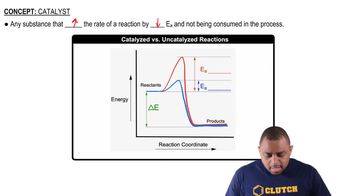
Identify the role of a catalyst in a chemical reaction: A catalyst provides an alternative reaction pathway with a lower activation energy.
Understand that the activation energy is the minimum energy required for a reaction to occur. Lowering this energy increases the number of effective collisions between reactant molecules.
Recognize that by lowering the activation energy, a catalyst increases the rate of the reaction without being consumed in the process.
Note that the presence of a catalyst does not affect the equilibrium position of the reaction; it only helps the system reach equilibrium faster.
Conclude that the addition of a catalyst will increase the rate of the reaction by providing a more efficient pathway for the reaction to proceed.

Risposta video verificata per un problema simile:

Questa soluzione video è stata consigliata dai nostri tutor come utile per risolvere questo problema.
Durata del video:
2m

Concetti chiave

Ecco i concetti essenziali che devi comprendere per rispondere correttamente alla domanda.

Catalysts

A catalyst is a substance that increases the rate of a chemical reaction without being consumed in the process. It works by providing an alternative reaction pathway with a lower activation energy, allowing more reactant molecules to collide with sufficient energy to react. This means that even at lower temperatures, reactions can proceed more quickly when a catalyst is present.
Video consigliato:
Percorso guidato
01:59
Catalyzed vs. Uncatalyzed Reactions

Reaction Rate

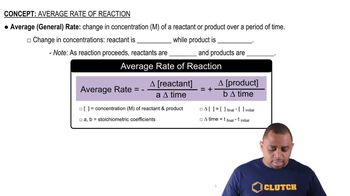
The reaction rate refers to the speed at which reactants are converted into products in a chemical reaction. It can be influenced by several factors, including concentration, temperature, and the presence of a catalyst. Understanding how these factors affect the reaction rate is crucial for predicting how changes in conditions will impact the overall progress of a reaction.
Video consigliato:
Percorso guidato
02:03
Average Rate of Reaction

Equilibrium and Dynamic Processes

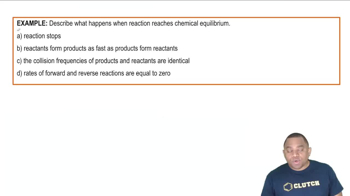
In a chemical reaction, equilibrium is reached when the rate of the forward reaction equals the rate of the reverse reaction, resulting in constant concentrations of reactants and products. The addition of a catalyst does not change the position of equilibrium; it only accelerates the time taken to reach that equilibrium. This concept is essential for understanding how catalysts influence reaction kinetics without altering the final outcome.
Video consigliato:
Percorso guidato
01:18
Chemical Equilibrium Example