
Ch.14 - Chemical Kinetics
McMurry - Chemistry 8th Edition
McMurry8th EditionChemistryISBN: 9781292336145Non è quello che usi tu?Cambia libro di testo
Capitolo 14, Problema 124

Consider the reaction H₂(g) + I₂(g) ⇌ 2 HI(g). The reaction of a fixed amount of H₂ and I₂ is studied in a cylinder fitted with a movable piston. Indicate the effect of each of the following changes on the rate of the reaction. (b) An increase in volume at constant temperature

Guida verificata passo dopo passo
1
Understand the relationship between volume and pressure: According to Boyle's Law, increasing the volume of a gas at constant temperature will decrease its pressure.
Consider the effect of pressure on reaction rate: For gaseous reactions, a decrease in pressure (due to increased volume) generally leads to a decrease in the concentration of reactants.
Apply the concept of concentration and reaction rate: The rate of a chemical reaction is often proportional to the concentration of the reactants. Lower concentration typically results in a slower reaction rate.
Relate the change to the reaction equilibrium: For the reaction H₂(g) + I₂(g) ⇌ 2 HI(g), a decrease in pressure (or increase in volume) will shift the equilibrium position according to Le Chatelier's Principle, potentially affecting the rate at which equilibrium is reached.
Summarize the effect: An increase in volume at constant temperature will likely decrease the rate of the reaction due to the reduced concentration of gaseous reactants.

Concetti chiave

Ecco i concetti essenziali che devi comprendere per rispondere correttamente alla domanda.

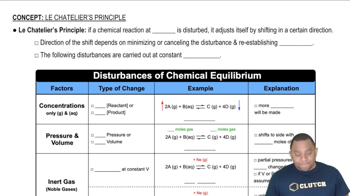
Le Chatelier's Principle

Le Chatelier's Principle states that if a dynamic equilibrium is disturbed by changing the conditions, the system will adjust to counteract the change and restore a new equilibrium. In the context of gas reactions, changes in volume can affect the concentrations of reactants and products, prompting the system to shift in a direction that minimizes the effect of the change.
Video consigliato:
Percorso guidato
07:32
Le Chatelier's Principle

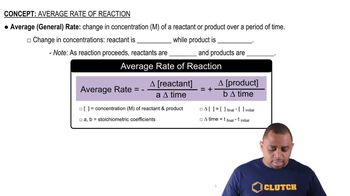
Reaction Rate

The reaction rate refers to the speed at which reactants are converted into products in a chemical reaction. It is influenced by factors such as concentration, temperature, and volume. In gas-phase reactions, increasing the volume decreases the concentration of gaseous reactants, which can slow down the reaction rate as fewer molecules are available to collide and react.
Video consigliato:
Percorso guidato
02:03
Average Rate of Reaction

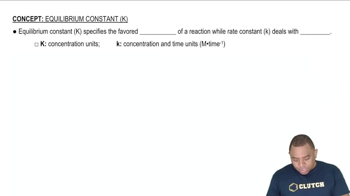
Equilibrium Constant (K)

The equilibrium constant (K) is a numerical value that expresses the ratio of the concentrations of products to reactants at equilibrium for a given reaction at a specific temperature. For the reaction H₂(g) + I₂(g) ⇌ 2 HI(g), changes in volume affect the concentrations of H₂ and I₂, which can shift the position of equilibrium but does not change the value of K unless the temperature changes.
Video consigliato:
Percorso guidato
01:14
Equilibrium Constant K