Ch.14 - Chemical Kinetics
McMurry - Chemistry 8th Edition
McMurry8th EditionChemistryISBN: 9781292336145Non è quello che usi tu?Cambia libro di testo
Capitolo 14, Problema 92c

Consider three reactions with different values of Ea and ΔE:
Reaction 1. Ea = 20 kJ>mol; ΔE = -60 kJ/mol
Reaction 2. Ea = 10 kJ>mol; ΔE = -20 kJ/mol
Reaction 3. Ea = 40 kJ>mol; ΔE = +15 kJ/mol
(c) Which reaction is the most endothermic, and which is the most exothermic?

Guida verificata passo dopo passo
1
Understand the terms: 'endothermic' means the reaction absorbs energy (ΔE is positive), and 'exothermic' means the reaction releases energy (ΔE is negative).
Identify the ΔE values for each reaction: Reaction 1 has ΔE = -60 kJ/mol, Reaction 2 has ΔE = -20 kJ/mol, and Reaction 3 has ΔE = +15 kJ/mol.
Compare the ΔE values: The most exothermic reaction will have the most negative ΔE value, and the most endothermic reaction will have the most positive ΔE value.
Determine the most exothermic reaction: Look for the reaction with the largest negative ΔE value.
Determine the most endothermic reaction: Look for the reaction with the largest positive ΔE value.

Risposta video verificata per un problema simile:

Questa soluzione video è stata consigliata dai nostri tutor come utile per risolvere questo problema.
Durata del video:
4m

Concetti chiave

Ecco i concetti essenziali che devi comprendere per rispondere correttamente alla domanda.

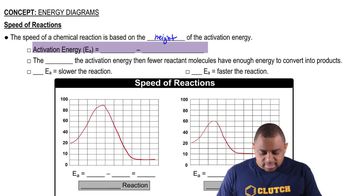
Activation Energy (E<sub>a</sub>)

Activation energy is the minimum energy required for a chemical reaction to occur. It represents the energy barrier that reactants must overcome to transform into products. A lower activation energy indicates that a reaction can proceed more easily, while a higher activation energy suggests a slower reaction rate. Understanding E<sub>a</sub> is crucial for analyzing reaction kinetics and determining how temperature and catalysts can influence reaction rates.
Video consigliato:
Percorso guidato
02:02
Speed of Reactions

Enthalpy Change (ΔE)

Enthalpy change (ΔE) refers to the heat content change during a chemical reaction at constant pressure. It indicates whether a reaction is exothermic (releases heat, ΔE < 0) or endothermic (absorbs heat, ΔE > 0). The magnitude of ΔE helps in understanding the energy dynamics of the reaction, which is essential for predicting the feasibility and direction of the reaction under given conditions.
Video consigliato:
Percorso guidato
02:34
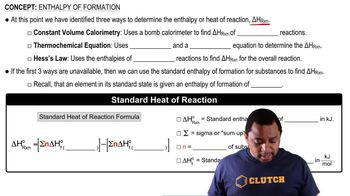
Enthalpy of Formation

Exothermic vs. Endothermic Reactions

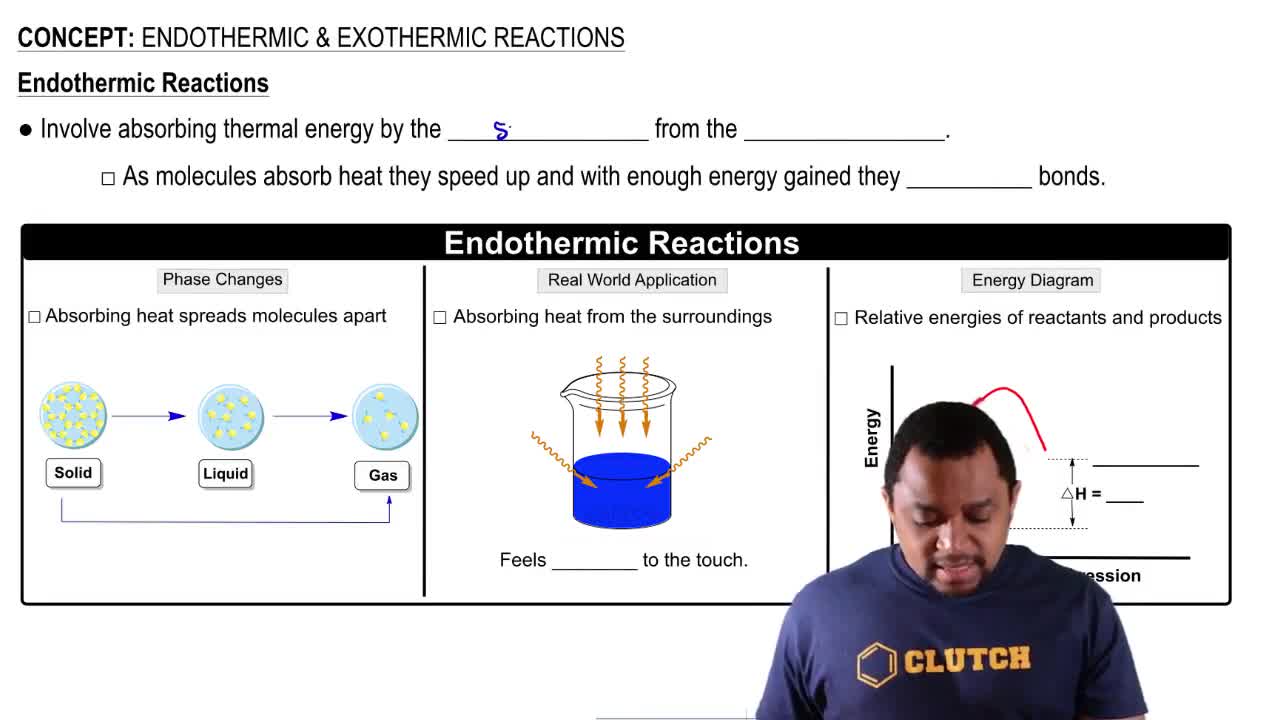
Exothermic reactions release energy to the surroundings, resulting in a negative ΔE, while endothermic reactions absorb energy, leading to a positive ΔE. The classification of reactions as exothermic or endothermic is important for understanding energy flow in chemical processes. In the context of the given reactions, identifying which has the most negative ΔE indicates the most exothermic reaction, while the one with the highest positive ΔE indicates the most endothermic reaction.
Video consigliato:
Percorso guidato
02:30
Endothermic & Exothermic Reactions
Pratica correlata
Domanda del libro di testo
What fraction of the molecules in a gas at 300 K collide with an energy equal to or greater than Ea when Ea equals 50 kJ/mol? What is the value of this fraction when Ea is 100 kJ/mol?
634
views

Domanda del libro di testo
If the rate of a reaction increases by a factor of 2.5 when the temperature is raised from 20 °C to 30 °C, what is the value of the activation energy in kJ/mol? By what factor does the rate of this reaction increase when the temperature is raised from 120 °C to 130 °C?
1085
views
1
comments
Domanda del libro di testo
You wish to determine the activation energy for the following first-order reaction: AS B + C (b) How would you use these data to determine the activation energy?
473
views
Domanda del libro di testo

Consider three reactions with different values of Ea and ΔE:

Reaction 1. Ea = 20 kJ>mol; ΔE = -60 kJ/mol

Reaction 2. Ea = 10 kJ>mol; ΔE = -20 kJ/mol

Reaction 3. Ea = 40 kJ>mol; ΔE = +15 kJ/mol

(b) Assuming that all three reactions are carried out at the same temperature and that all three have the same frequency factor A, which reaction is the fastest and which is the slowest?

514
views
Domanda del libro di testo
A certain first-order reaction has a rate constant of 1.0 * 10-3 s-1 at 25 °C. (b) What is the Ea (in kJ/mol) if the same temperature change causes the rate to triple?
1393
views
1
rank
Domanda del libro di testo
The values of Ea = 248 kJ>mol and ΔE = 41 kJ>mol have been measured for the reaction H21g2 + CO21g2S H2O1g2 + CO1g2 (b) Considering the geometry of the reactants and products, suggest a plausible structure for the transition state.
468
views