Ch.14 - Chemical Kinetics
McMurry - Chemistry 8th Edition
McMurry8th EditionChemistryISBN: 9781292336145Non è quello che usi tu?Cambia libro di testo
Capitolo 14, Problema 91

The values of Ea = 248 kJ>mol and ΔE = 41 kJ>mol have been measured for the reaction H21g2 + CO21g2S H2O1g2 + CO1g2 (b) Considering the geometry of the reactants and products, suggest a plausible structure for the transition state.

Guida verificata passo dopo passo
1
Understand the reaction: The given reaction is H2(g) + CO2(g) -> H2O(g) + CO(g). This is a gas-phase reaction where hydrogen gas reacts with carbon dioxide to form water vapor and carbon monoxide.
Identify the transition state: The transition state is a high-energy, unstable arrangement of atoms that occurs during the conversion of reactants to products. It represents the point of highest energy along the reaction path.
Consider the geometry: In the transition state, bonds are partially broken and formed. For this reaction, the H-H bond in H2 and the C=O bond in CO2 are likely to be breaking, while new bonds (O-H in H2O and C-O in CO) are forming.
Visualize the transition state: A plausible structure for the transition state might involve a complex where the hydrogen atoms are simultaneously interacting with the oxygen atom of CO2 and the carbon atom of CO2, forming a four-center transition state.
Use the energy values: The activation energy (Ea = 248 kJ/mol) and the change in energy (ΔE = 41 kJ/mol) suggest that the transition state is significantly higher in energy than the reactants, indicating a significant reorganization of bonds.

Risposta video verificata per un problema simile:

Questa soluzione video è stata consigliata dai nostri tutor come utile per risolvere questo problema.
Durata del video:
2m

Concetti chiave

Ecco i concetti essenziali che devi comprendere per rispondere correttamente alla domanda.

Activation Energy (Ea)

Activation energy (Ea) is the minimum energy required for a chemical reaction to occur. It represents the energy barrier that reactants must overcome to form products. In this context, a high Ea value, such as 248 kJ/mol, indicates that the reaction is relatively slow and requires significant energy input to proceed.
Video consigliato:
Percorso guidato
02:02
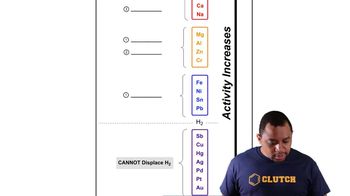
Activity Series Chart

Transition State

The transition state is a high-energy, unstable arrangement of atoms that occurs during the transformation from reactants to products. It represents the point at which bonds are breaking and forming, and it is characterized by a specific geometry that reflects the arrangement of atoms at this critical moment. Understanding the transition state is essential for predicting reaction pathways and mechanisms.
Video consigliato:
Percorso guidato
03:12
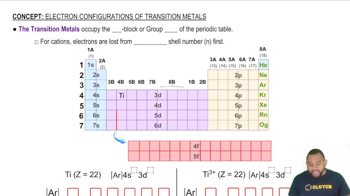
Transition Metals

Reaction Coordinate

The reaction coordinate is a conceptual representation of the progress of a chemical reaction, illustrating the energy changes as reactants convert to products. It typically shows the energy of the system as a function of the reaction progress, highlighting the activation energy and the transition state. Analyzing the reaction coordinate helps in visualizing how molecular structures change during the reaction.
Video consigliato:
Percorso guidato
00:27
Coordination Numbers
Pratica correlata
Domanda del libro di testo
What fraction of the molecules in a gas at 300 K collide with an energy equal to or greater than Ea when Ea equals 50 kJ/mol? What is the value of this fraction when Ea is 100 kJ/mol?
634
views

Domanda del libro di testo

Consider three reactions with different values of Ea and ΔE:

Reaction 1. Ea = 20 kJ>mol; ΔE = -60 kJ/mol

Reaction 2. Ea = 10 kJ>mol; ΔE = -20 kJ/mol

Reaction 3. Ea = 40 kJ>mol; ΔE = +15 kJ/mol

(c) Which reaction is the most endothermic, and which is the most exothermic?

466
views
Domanda del libro di testo

Consider three reactions with different values of Ea and ΔE:

Reaction 1. Ea = 20 kJ>mol; ΔE = -60 kJ/mol

Reaction 2. Ea = 10 kJ>mol; ΔE = -20 kJ/mol

Reaction 3. Ea = 40 kJ>mol; ΔE = +15 kJ/mol

(b) Assuming that all three reactions are carried out at the same temperature and that all three have the same frequency factor A, which reaction is the fastest and which is the slowest?

514
views
Domanda del libro di testo
Two reactions have the same activation energy, but their rates at the same temperature differ by a factor of 10. Explain.
751
views
Domanda del libro di testo
A certain first-order reaction has a rate constant of 1.0 * 10-3 s-1 at 25 °C. (b) What is the Ea (in kJ/mol) if the same temperature change causes the rate to triple?
1393
views
1
rank
Domanda del libro di testo
When the temperature of a gas is raised by 10 °C, the collision frequency increases by only about 2%, but the reaction rate increases by 100% (a factor of 2) or more. Explain.
582
views