
Some reactions are so rapid that they are said to be diffusion-controlled; that is, the reactants react as quickly as they can collide. An example is the neutralization of H3O+ by OH-, which has a second-order rate constant of 1.3⨉1011 M-1 s-1 at 25 °C. (a) If equal volumes of 2.0 M HCl and 2.0 M NaOH are mixed instantaneously, how much time is required for 99.999% of the acid to be neutralized?
Ch.14 - Chemical Kinetics
Capitolo 14, Problema 131
The reaction 2 NO1g2 + O21g2S 2 NO21g2 has the thirdorder rate law rate = k3NO423O24, where k = 25 M-2 s-1. Under the condition that 3NO4 = 2 3O24, the integrated rate law is 13O242 = 8 kt +113O24022 What are the concentrations of NO, O2, and NO2 after 100.0 s if the initial concentrations are 3NO4 = 0.0200 M and 3O24 = 0.0100 M?
Guida verificata passo dopo passo1
Identify the given reaction and rate law: The reaction is 2 NO(g) + O2(g) -> 2 NO2(g) with a third-order rate law: rate = k[NO]^2[O2].
Note the given rate constant k = 25 M^-2 s^-1 and the condition [NO] = 2[O2].
Use the integrated rate law provided: 1/[O2] = 8kt + 1/[O2]_0^2, where [O2]_0 is the initial concentration of O2.
Substitute the initial concentration of O2 ([O2]_0 = 0.0100 M) and the time (t = 100.0 s) into the integrated rate law to solve for [O2].
Once [O2] is found, use the condition [NO] = 2[O2] to find [NO], and use stoichiometry to find [NO2] based on the initial concentrations and changes in [NO] and [O2].

Risposta video verificata per un problema simile:
Questa soluzione video è stata consigliata dai nostri tutor come utile per risolvere questo problema.
Durata del video:
6mConcetti chiave
Ecco i concetti essenziali che devi comprendere per rispondere correttamente alla domanda.
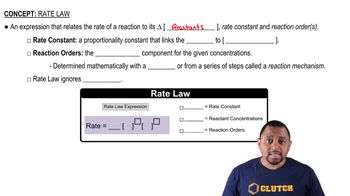
Rate Laws
Rate laws express the relationship between the rate of a chemical reaction and the concentration of its reactants. In this case, the rate law is third-order, indicating that the rate depends on the concentrations of NO and O2 raised to the power of their stoichiometric coefficients. Understanding how to interpret and apply rate laws is essential for predicting how changes in concentration affect the reaction rate.
Video consigliato:
Percorso guidato
Rate Law Fundamentals
Integrated Rate Laws
Integrated rate laws relate the concentrations of reactants to time, allowing for the calculation of concentrations at any given time during the reaction. The provided integrated rate law for this reaction shows how the concentration of O2 changes over time, which is crucial for determining the concentrations of all species after a specified duration. Mastery of integrated rate laws is vital for solving kinetics problems.
Video consigliato:
Percorso guidato
Rate Law Fundamentals
Stoichiometry
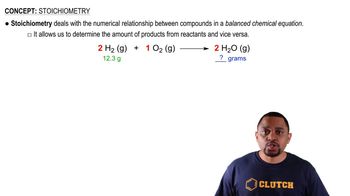
Stoichiometry involves the quantitative relationships between reactants and products in a chemical reaction. In this question, the stoichiometric coefficients from the balanced equation are used to relate the initial concentrations of NO and O2 to the concentrations of NO2 produced. A solid understanding of stoichiometry is necessary to accurately calculate the concentrations of all species involved in the reaction.
Video consigliato:
Percorso guidato
Stoichiometry Concept
Pratica correlata
Domanda del libro di testo
1078
views
Domanda del libro di testo
The half-life for the first-order decomposition of N2O4 is
1.3 * 10-5 s.
N2O41g2S 2 NO21g2
If N2O4 is introduced into an evacuated flask at a pressure
of 17.0 mm Hg, how many seconds are required for the
pressure of NO2 to reach 1.3 mm Hg?
1180
views
Domanda del libro di testo
Some reactions are so rapid that they are said to be diffusion-controlled; that is, the reactants react as quickly as they can collide. An example is the neutralization of H3O+ by OH-, which has a second-order rate constant of 1.3⨉1011 M-1 s-1 at 25 °C. (b) Under normal laboratory conditions, would you expect the rate of the acid–base neutralization to be limited by the rate of the reaction or by the speed of mixing?
597
views
Domanda del libro di testo
The following experimental data were obtained in a study
of the reaction 2 HI1g2S H21g2 + I21g2. Predict the concentration
of HI that would give a rate of 1.0 * 10-5 M>s
at 650 K.
709
views
1
rank
