
Ch.14 - Chemical Kinetics
McMurry - Chemistry 8th Edition
McMurry8th EditionChemistryISBN: 9781292336145Non è quello che usi tu?Cambia libro di testo
Capitolo 14, Problema 134

The following experimental data were obtained in a study of the reaction 2 HI1g2S H21g2 + I21g2. Predict the concentration of HI that would give a rate of 1.0 * 10-5 M>s at 650 K. Table showing experimental data for the reaction 2 HI -> H2 + I2, with temperature and reaction rates.

Guida verificata passo dopo passo
1
Step 1: Identify the rate law for the reaction. The general form of the rate law is rate = k[HI]^n, where k is the rate constant and n is the order of the reaction with respect to HI.
Step 2: Use the data from experiments 1 and 2 to determine the order of the reaction (n). Compare the rates and concentrations to find the relationship between them.
Step 3: Calculate the rate constant (k) using the data from one of the experiments (e.g., experiment 1). Use the rate law and the known concentration and rate to solve for k.
Step 4: Use the rate law and the calculated rate constant (k) to predict the concentration of HI that would give a rate of 1.0 * 10^-5 M/s at 650 K.
Step 5: Solve for the concentration of HI by rearranging the rate law equation to isolate [HI] and substituting the given rate and calculated rate constant.

Risposta video verificata per un problema simile:

Questa soluzione video è stata consigliata dai nostri tutor come utile per risolvere questo problema.
Durata del video:
9m

Concetti chiave

Ecco i concetti essenziali che devi comprendere per rispondere correttamente alla domanda.

Rate of Reaction

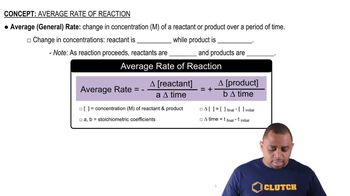
The rate of reaction refers to the speed at which reactants are converted into products in a chemical reaction. It is typically expressed in terms of concentration change over time, such as moles per liter per second (M/s). Understanding how concentration affects the rate is crucial, as higher concentrations of reactants generally lead to increased reaction rates due to more frequent collisions between molecules.
Video consigliato:
Percorso guidato
02:03
Average Rate of Reaction

Temperature and Reaction Rate

Temperature plays a significant role in influencing the rate of chemical reactions. As temperature increases, the kinetic energy of molecules also increases, leading to more frequent and energetic collisions. This often results in a higher reaction rate. The Arrhenius equation quantitatively describes this relationship, showing how temperature affects the rate constant of a reaction.
Video consigliato:
Percorso guidato
02:03
Average Rate of Reaction

Concentration and Rate Law

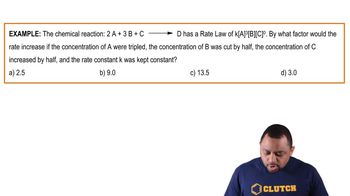
The rate law expresses the relationship between the rate of a chemical reaction and the concentration of its reactants. It is typically formulated as rate = k[A]^m[B]^n, where k is the rate constant, and m and n are the orders of the reaction with respect to reactants A and B. By analyzing experimental data, one can determine the order of the reaction and predict how changes in concentration will affect the reaction rate.
Video consigliato:
Percorso guidato
02:10
Concentration Changes and Rate Law Example