
Ch.14 - Chemical Kinetics
McMurry - Chemistry 8th Edition
McMurry8th EditionChemistryISBN: 9781292336145Non è quello che usi tu?Cambia libro di testo
Capitolo 14, Problema 61

The reaction 2NO1g2 + 2 H21g2S N21g2 + 2 H2O1g2 is first order in H2 and second order in NO. Write the rate law, and specify the units of the rate constant.

Guida verificata passo dopo passo
1
insert step 1> Identify the order of the reaction with respect to each reactant. The reaction is first order in H_2 and second order in NO.
insert step 2> Write the general form of the rate law for the reaction. The rate law is expressed as: rate = k [NO]^m [H_2]^n, where k is the rate constant, m is the order with respect to NO, and n is the order with respect to H_2.
insert step 3> Substitute the given orders into the rate law. Since the reaction is second order in NO and first order in H_2, the rate law becomes: rate = k [NO]^2 [H_2]^1.
insert step 4> Determine the overall order of the reaction by adding the exponents of the concentration terms in the rate law. The overall order is 2 (for NO) + 1 (for H_2) = 3.
insert step 5> Specify the units of the rate constant k. For a reaction of overall order n, the units of k are typically (L^(n-1) mol^(1-n) s^(-1)). For this third-order reaction, the units of k are L^2 mol^(-2) s^(-1).

Risposta video verificata per un problema simile:

Questa soluzione video è stata consigliata dai nostri tutor come utile per risolvere questo problema.
Durata del video:
3m

Concetti chiave

Ecco i concetti essenziali che devi comprendere per rispondere correttamente alla domanda.

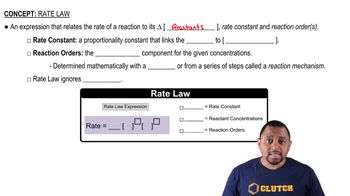
Rate Law

The rate law expresses the relationship between the rate of a chemical reaction and the concentration of its reactants. It is typically formulated as Rate = k[A]^m[B]^n, where k is the rate constant, [A] and [B] are the concentrations of the reactants, and m and n are their respective orders. For the given reaction, the rate law can be written based on the specified orders of the reactants.
Video consigliato:
Percorso guidato
01:52
Rate Law Fundamentals

Order of Reaction

The order of a reaction refers to the power to which the concentration of a reactant is raised in the rate law. It indicates how the rate of reaction is affected by changes in concentration. In this case, the reaction is first order in H2 and second order in NO, meaning that the rate is directly proportional to the concentration of H2 and proportional to the square of the concentration of NO.
Video consigliato:
Percorso guidato
00:36
Average Bond Order

Units of the Rate Constant (k)

The units of the rate constant depend on the overall order of the reaction. For a reaction that is first order in one reactant and second order in another, the overall order is three. The units of k can be derived from the rate law, where the rate is typically expressed in mol/L·s. Thus, for a third-order reaction, the units of k would be L^2/(mol^2·s).
Video consigliato:
Percorso guidato
01:14
Equilibrium Constant K
Pratica correlata
Domanda del libro di testo
Chlorite is reduced by bromide in acidic solution according to the following balanced equation: ClO2 -1aq2 + 4 Br-1aq2 + 4 H+1aq2S Cl-1aq2 + 2 Br21aq2 + 2 H2O1l2 (a) If Δ3Br24>Δt = 4.8 * 10-6 M>s, what is the value of Δ3ClO2 -4>Δt during the same time interval?
510
views
Domanda del libro di testo
Initial rate data at 25 °C are listed in the table for the reaction NH4 +1aq2 + NO2 -1aq2S N21g2 + 2 H2O1l2 (b) What is the value of the rate constant?

510
views
Domanda del libro di testo
Ammonia is manufactured in large amounts by the reaction N21g2 + 3 H21g2S 2 NH31g2 (b) How is the rate of formation of NH3 related to the rate of consumption of N2?
366
views
Domanda del libro di testo
Trimethylamine and chlorine dioxide react in water in an electron transfer reaction to form the trimethylamine cation and chlorite ion: 1CH323 N1aq2 + ClO21aq2 + H2O1l2S 1CH323 NH+1aq2 + ClO2 -1aq2 + OH-1aq2 Initial rate data obtained at 23 °C are listed in the following table. (b) What would be the initial rate in an experiment with initial concentrations 31CH323 N4 = 4.2 * 10-2 M and 3ClO24 = 3.4 * 10-2 M?
533
views
Domanda del libro di testo

Ammonia is manufactured in large amounts by the reaction

N2(g) + 3 H2(g) → 2 NH3(g)

(a) How is the rate of consumption of H2 related to the rate of consumption of N2?

119
views