
Ch.14 - Chemical Kinetics
McMurry - Chemistry 8th Edition
McMurry8th EditionChemistryISBN: 9781292336145Non è quello che usi tu?Cambia libro di testo
Capitolo 14, Problema 69

Trimethylamine and chlorine dioxide react in water in an electron transfer reaction to form the trimethylamine cation and chlorite ion: 1CH323 N1aq2 + ClO21aq2 + H2O1l2S 1CH323 NH+1aq2 + ClO2 -1aq2 + OH-1aq2 Initial rate data obtained at 23 °C are listed in the following table. (b) What would be the initial rate in an experiment with initial concentrations 31CH323 N4 = 4.2 * 10-2 M and 3ClO24 = 3.4 * 10-2 M?
Guida verificata passo dopo passo
1
Identify the rate law expression for the reaction. The rate law is generally expressed as: \( \text{Rate} = k [\text{CH}_3)_3\text{N}]^m [\text{ClO}_2]^n \), where \( k \) is the rate constant, and \( m \) and \( n \) are the reaction orders with respect to trimethylamine and chlorine dioxide, respectively.
Use the initial rate data provided in the table to determine the reaction orders \( m \) and \( n \). This typically involves comparing experiments where the concentration of one reactant is varied while the other is held constant.
Once the reaction orders \( m \) and \( n \) are determined, calculate the rate constant \( k \) using one of the experiments from the table. Substitute the known concentrations and the initial rate into the rate law expression to solve for \( k \).
With the rate constant \( k \) and the reaction orders \( m \) and \( n \) known, substitute the given initial concentrations \([\text{CH}_3)_3\text{N}] = 4.2 \times 10^{-2} \text{ M}\) and \([\text{ClO}_2] = 3.4 \times 10^{-2} \text{ M}\) into the rate law expression.
Calculate the initial rate using the rate law expression with the substituted values. This will give you the initial rate for the specified concentrations.

Risposta video verificata per un problema simile:

Questa soluzione video è stata consigliata dai nostri tutor come utile per risolvere questo problema.
Durata del video:
7m

Concetti chiave

Ecco i concetti essenziali che devi comprendere per rispondere correttamente alla domanda.

Electron Transfer Reactions

Electron transfer reactions, also known as redox reactions, involve the transfer of electrons between chemical species. In this context, trimethylamine donates electrons to chlorine dioxide, resulting in the formation of the trimethylamine cation and the chlorite ion. Understanding the roles of oxidizing and reducing agents in these reactions is crucial for predicting the products and the overall reaction mechanism.
Video consigliato:
Percorso guidato
03:29
Electron Capture & Positron Emission Reaction Example

Rate of Reaction

The rate of reaction refers to the speed at which reactants are converted into products. It can be influenced by factors such as concentration, temperature, and the presence of catalysts. In this question, the initial rate is determined by the concentrations of trimethylamine and chlorine dioxide, which can be analyzed using rate laws to predict how changes in concentration affect the reaction rate.
Video consigliato:
Percorso guidato
02:03
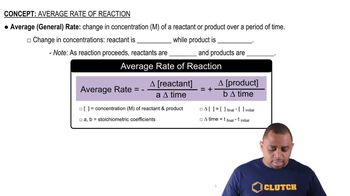
Average Rate of Reaction

Concentration and Stoichiometry

Concentration is a measure of the amount of a substance in a given volume of solution, typically expressed in molarity (M). Stoichiometry involves the quantitative relationships between reactants and products in a chemical reaction. In this scenario, understanding the initial concentrations of trimethylamine and chlorine dioxide is essential for calculating the initial rate of the reaction, as it directly impacts the reaction dynamics according to the stoichiometric coefficients.
Video consigliato:
Percorso guidato
01:16
Stoichiometry Concept
(b) What is the value of the rate constant?

Domanda del libro di testo
What is the half-life (in minutes) of the reaction in Problem 14.74 when the initial C4H6 concentration is 0.0200 M? How many minutes does it take for the concentration of C4H6 to drop from 0.0100 M to 0.0050 M?
834
views
Domanda del libro di testo
The reaction 2NO1g2 + 2 H21g2S N21g2 + 2 H2O1g2 is first order in H2 and second order in NO. Write the rate law, and specify the units of the rate constant.
310
views