
Ch.14 - Chemical Kinetics
McMurry - Chemistry 8th Edition
McMurry8th EditionChemistryISBN: 9781292336145Non è quello che usi tu?Cambia libro di testo
Capitolo 14, Problema 105

What distinguishes the rate-determining step from the other steps in a reaction mechanism? How does the ratedetermining step affect the observed rate law?

Guida verificata passo dopo passo
1
Understand that a reaction mechanism is composed of a series of elementary steps, each with its own rate, which together describe how the overall reaction occurs.
Identify the rate-determining step (RDS) as the slowest step in the reaction mechanism. This step has the highest activation energy barrier to overcome compared to other steps in the mechanism.
Recognize that because the rate-determining step is the slowest, it limits the rate at which the overall reaction proceeds. The overall reaction cannot proceed faster than this slowest step.
Learn that the rate law of the overall reaction is determined by the rate-determining step. The molecularity and the concentration of reactants involved in the RDS dictate the form of the rate law.
Apply the concept that the coefficients of reactants in the rate law are derived from the stoichiometry of the rate-determining step, not necessarily from the overall balanced equation of the reaction.

Risposta video verificata per un problema simile:

Questa soluzione video è stata consigliata dai nostri tutor come utile per risolvere questo problema.
Durata del video:
2m

Concetti chiave

Ecco i concetti essenziali che devi comprendere per rispondere correttamente alla domanda.

Rate-Determining Step

The rate-determining step (RDS) is the slowest step in a reaction mechanism that limits the overall rate of the reaction. It is the step with the highest activation energy, meaning it requires the most energy to proceed. Because the RDS is the bottleneck of the reaction pathway, the rate of the entire reaction is primarily determined by this step.
Video consigliato:
Percorso guidato
01:15
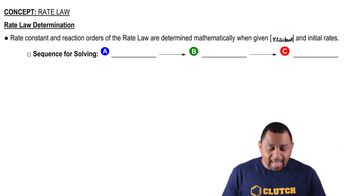
Rate Law Determination

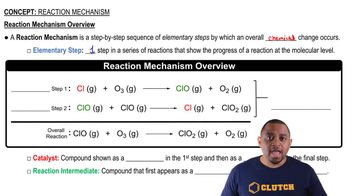
Reaction Mechanism

A reaction mechanism is a detailed description of the individual steps that occur during a chemical reaction. Each step involves the breaking and forming of bonds and can vary in speed. Understanding the mechanism helps chemists predict how changes in conditions (like concentration or temperature) will affect the reaction rate and the overall process.
Video consigliato:
Percorso guidato
03:06
Reaction Mechanism Overview

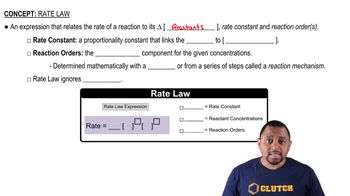
Rate Law

The rate law is an equation that relates the rate of a chemical reaction to the concentration of its reactants. It is derived from the stoichiometry of the rate-determining step, where the rate is proportional to the concentrations of the reactants raised to their respective powers. The rate law provides insight into the relationship between the reaction mechanism and the observed reaction rate, highlighting the influence of the RDS.
Video consigliato:
Percorso guidato
01:52
Rate Law Fundamentals