

Ch.15 - Chemical Equilibrium
McMurry - Chemistry 8th Edition
McMurry8th EditionChemistryISBN: 9781292336145Non è quello che usi tu?Cambia libro di testo
Capitolo 15, Problema 83

At 500 K, the equilibrium constant for the dissociation reaction H2(g) ⇌ 2H(g) is very small (Kc = 1.2 × 10⁻⁴²). (a) What is the molar concentration of H atoms at equilibrium if the equilibrium concentration of H2 is 0.10 M? (b) How many H atoms and H2 molecules are present in 1.0 L of 0.10 M H2 at 500 K?

Guida verificata passo dopo passo
1
Step 1: Write the expression for the equilibrium constant (Kc) for the reaction H2(g) ⇌ 2H(g). The expression is Kc = [H]^2 / [H2].
Step 2: Substitute the given values into the Kc expression. You know Kc = 1.2 × 10⁻⁴² and [H2] = 0.10 M. So, 1.2 × 10⁻⁴² = [H]^2 / 0.10.
Step 3: Solve for [H] by rearranging the equation to find [H]^2 = Kc × [H2]. Then, calculate [H] by taking the square root of the result.
Step 4: For part (b), calculate the number of moles of H2 in 1.0 L of 0.10 M solution using the formula: moles = concentration × volume.
Step 5: Use the concentration of H atoms found in part (a) to calculate the number of moles of H atoms in 1.0 L, and then convert these moles to the number of atoms using Avogadro's number.

Concetti chiave

Ecco i concetti essenziali che devi comprendere per rispondere correttamente alla domanda.

Equilibrium Constant (Kc)

The equilibrium constant (Kc) is a numerical value that expresses the ratio of the concentrations of products to reactants at equilibrium for a given reaction at a specific temperature. A small Kc value, like 1.2 × 10⁻⁴², indicates that the reaction favors the reactants (H2) over the products (H atoms), suggesting that at equilibrium, the concentration of H atoms will be very low compared to H2.
Video consigliato:
Percorso guidato
03:20
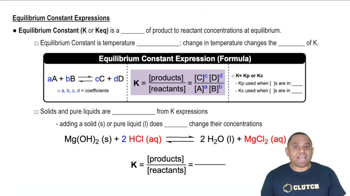
Equilibrium Constant Expressions

Dissociation Reaction

A dissociation reaction involves the breaking apart of a compound into its constituent elements or simpler compounds. In this case, H2(g) dissociates into 2H(g). Understanding this reaction is crucial for calculating the concentrations of H atoms at equilibrium, as it directly relates to how the initial concentration of H2 influences the formation of H atoms.
Video consigliato:
Percorso guidato
04:52
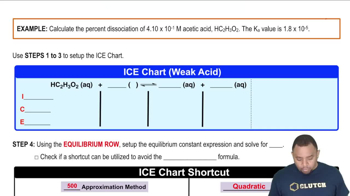
Percent Dissociation Example

Stoichiometry

Stoichiometry is the calculation of reactants and products in chemical reactions based on the balanced chemical equation. In this scenario, the stoichiometric coefficients indicate that one mole of H2 produces two moles of H atoms. This relationship is essential for determining the molar concentrations of H atoms and H2 in the system, allowing for accurate calculations of their quantities at equilibrium.
Video consigliato:
Percorso guidato
01:16
Stoichiometry Concept