
Ch.15 - Chemical Equilibrium
McMurry - Chemistry 8th Edition
McMurry8th EditionChemistryISBN: 9781292336145Non è quello che usi tu?Cambia libro di testo
Capitolo 15, Problema 77

Which of the following reactions yield appreciable equilib- rium concentrations of both reactants and products? (a) 2 Cu1s2 + O21g2 ∆ 2 CuO1s2; Kc = 4 * 1045

Guida verificata passo dopo passo
1
Identify the reaction and the given equilibrium constant (Kc). The reaction is: 2 Cu(s) + O2(g) → 2 CuO(s) and Kc = 4 * 10^45.
Understand the meaning of the equilibrium constant (Kc). It quantifies the ratio of the concentrations of products to reactants at equilibrium, raised to the power of their stoichiometric coefficients.
Analyze the magnitude of Kc. A very large Kc (e.g., 10^45) suggests that the reaction heavily favors the formation of products at equilibrium.
Consider the implications of a large Kc on the concentrations of reactants and products. Since Kc is extremely large, the concentration of reactants (Cu and O2) at equilibrium will be very low compared to the concentration of the product (CuO).
Conclude whether both reactants and products have appreciable concentrations at equilibrium. Given the very high value of Kc, it indicates that the concentrations of reactants will be negligible, thus not appreciable, at equilibrium.

Risposta video verificata per un problema simile:

Questa soluzione video è stata consigliata dai nostri tutor come utile per risolvere questo problema.
Durata del video:
2m

Concetti chiave

Ecco i concetti essenziali che devi comprendere per rispondere correttamente alla domanda.

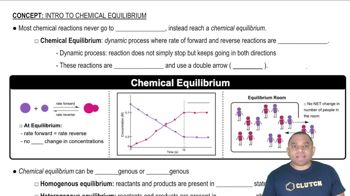
Chemical Equilibrium

Chemical equilibrium occurs when the rates of the forward and reverse reactions are equal, resulting in constant concentrations of reactants and products. At equilibrium, the system is dynamic, meaning that reactions continue to occur, but there is no net change in the concentrations. Understanding this concept is crucial for analyzing the extent to which a reaction proceeds and the conditions under which it reaches equilibrium.
Video consigliato:
Percorso guidato
04:21
Chemical Equilibrium Concepts

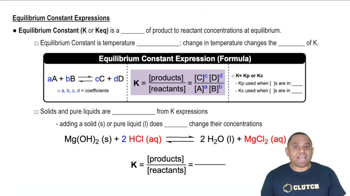
Equilibrium Constant (Kc)

The equilibrium constant (Kc) is a numerical value that expresses the ratio of the concentrations of products to reactants at equilibrium, each raised to the power of their coefficients in the balanced equation. A large Kc value, such as 4 * 10^45, indicates that at equilibrium, the concentration of products is much greater than that of reactants, suggesting that the reaction favors product formation. This concept helps predict the direction and extent of a reaction.
Video consigliato:
Percorso guidato
03:20
Equilibrium Constant Expressions

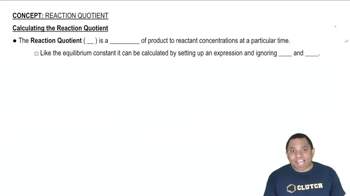
Reaction Quotient (Q)

The reaction quotient (Q) is a measure of the relative concentrations of reactants and products at any point in time, not just at equilibrium. By comparing Q to Kc, one can determine the direction in which a reaction will proceed to reach equilibrium. If Q < Kc, the reaction will shift to the right to produce more products; if Q > Kc, it will shift to the left to produce more reactants. This concept is essential for understanding how changes in conditions affect the position of equilibrium.
Video consigliato:
Percorso guidato
00:49
Reaction Quotient Q