
Ch.15 - Chemical Equilibrium
McMurry - Chemistry 8th Edition
McMurry8th EditionChemistryISBN: 9781292336145Non è quello che usi tu?Cambia libro di testo
Capitolo 15, Problema 3

Given the data for the following reactions at 298 K: N2(g) + O2(g) ⇌ 2 NO(g) Kp = 4.4 * 10^-31 NO(g) + 1/2 O2(g) ⇌ NO2(g) Kp = 1.5 * 10^6, calculate the value of the equilibrium constant Kp at 298 K for the reaction N2(g) + 2 O2(g) ⇌ 2 NO2(g). (LO 15.3) (a) Kp = 6.6 * 10^-25 (b) Kp = 1.3 * 10^-24 (c) Kp = 9.9 * 10^-19 (d) Kp = 5.4 * 10^-28

Guida verificata passo dopo passo
1
Step 1: Identify the target reaction: N2(g) + 2 O2(g) ⇌ 2 NO2(g).
Step 2: Recognize that the target reaction can be obtained by combining the given reactions: N2(g) + O2(g) ⇌ 2 NO(g) and NO(g) + 1/2 O2(g) ⇌ NO2(g).
Step 3: Reverse the first reaction to get 2 NO(g) ⇌ N2(g) + O2(g), which changes its Kp to 1/(4.4 * 10^-31).
Step 4: Multiply the second reaction by 2 to get 2 NO(g) + O2(g) ⇌ 2 NO2(g), which squares its Kp to (1.5 * 10^6)^2.
Step 5: Combine the modified reactions to form the target reaction and multiply their Kp values to find the Kp for the target reaction.

Concetti chiave

Ecco i concetti essenziali che devi comprendere per rispondere correttamente alla domanda.

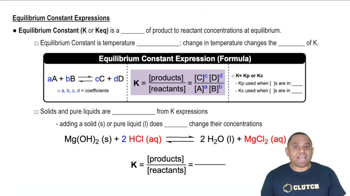
Equilibrium Constant (Kp)

The equilibrium constant (Kp) is a numerical value that expresses the ratio of the concentrations of products to reactants at equilibrium for a given reaction at a specific temperature. It is calculated using the partial pressures of gases involved in the reaction. A larger Kp indicates a greater tendency for products to form, while a smaller Kp suggests a preference for reactants.
Video consigliato:
Percorso guidato
03:20
Equilibrium Constant Expressions

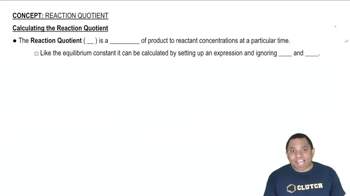
Reaction Quotient (Q)

The reaction quotient (Q) is a measure of the relative amounts of products and reactants present in a reaction at any point in time, not just at equilibrium. It is calculated in the same way as Kp but uses the current concentrations or partial pressures. Comparing Q to Kp helps determine the direction in which a reaction will proceed to reach equilibrium.
Video consigliato:
Percorso guidato
00:49
Reaction Quotient Q

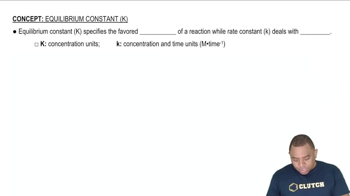
Manipulating Equilibrium Constants

When combining reactions to find the equilibrium constant for a new reaction, the equilibrium constants of the individual reactions can be manipulated. If a reaction is reversed, the equilibrium constant is inverted. If a reaction is multiplied by a coefficient, the equilibrium constant is raised to that power. This principle is essential for calculating Kp for complex reactions.
Video consigliato:
Percorso guidato
01:14
Equilibrium Constant K