
The F-F bond in F2 is relatively weak because the lone pairs of electrons on one F atom repel the lone pairs on the other F atom; Kp = 7.83 at 1500 K for the reaction F2(g) ⇌ 2 F(g). (c) Why is the F-F bond in F2 weaker than the Cl-Cl bond in Cl2?
Ch.15 - Chemical Equilibrium
Capitolo 15, Problema 153c
The equilibrium constant Kc for the gas-phase thermal decomposition of cyclopropane to propene is 1.0 * 105 at 500 K:
(c) Can you alter the ratio of the two concentrations at equilibrium by adding cyclopropane or by decreasing the volume of the container? Explain.
Guida verificata passo dopo passo1
Understand the reaction: The decomposition of cyclopropane (C3H6) to propene (C3H6) can be represented as C3H6 (cyclopropane)
ightarrow C3H6 (propene).
Recognize the nature of the equilibrium constant (Kc): A large Kc value (1.0 * 10^5) indicates that at equilibrium, the concentration of products (propene) is much higher compared to the concentration of reactants (cyclopropane).
Consider the effect of adding more cyclopropane: Adding more cyclopropane increases the concentration of the reactant. According to Le Chatelier's Principle, the system will adjust to partially counteract this change by producing more propene, thus shifting the equilibrium to the right.
Consider the effect of decreasing the volume: Decreasing the volume of the container increases the pressure of the system. Since the number of moles of gas does not change in this reaction (1 mole of cyclopropane produces 1 mole of propene), the change in pressure does not favor either the forward or reverse reaction significantly.
Conclude the effects: Adding cyclopropane will shift the equilibrium towards the products (propene), increasing their ratio at equilibrium. However, decreasing the volume will not significantly alter the ratio of cyclopropane to propene at equilibrium.

Risposta video verificata per un problema simile:
Questa soluzione video è stata consigliata dai nostri tutor come utile per risolvere questo problema.
Durata del video:
4mConcetti chiave
Ecco i concetti essenziali che devi comprendere per rispondere correttamente alla domanda.
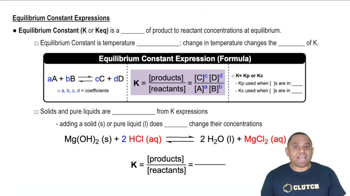
Equilibrium Constant (Kc)
The equilibrium constant (Kc) is a numerical value that expresses the ratio of the concentrations of products to reactants at equilibrium for a given reaction at a specific temperature. For the reaction involving cyclopropane and propene, Kc indicates the extent to which the reaction favors products or reactants. A high Kc value, like 1.0 * 10^5, suggests that at equilibrium, the concentration of products (propene) is much greater than that of reactants (cyclopropane).
Video consigliato:
Percorso guidato
Equilibrium Constant Expressions
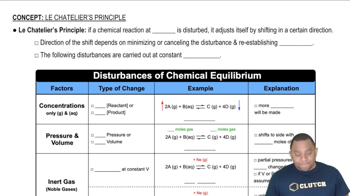
Le Chatelier's Principle
Le Chatelier's Principle states that if a dynamic equilibrium is disturbed by changing the conditions, the system will adjust itself to counteract the change and restore a new equilibrium. This principle can be applied to predict how the addition of cyclopropane or a change in volume will affect the concentrations of reactants and products at equilibrium. For instance, adding more cyclopropane will shift the equilibrium towards the products to reduce the concentration of the added reactant.
Video consigliato:
Percorso guidato
Le Chatelier's Principle
Effect of Volume on Gas Equilibrium
In gas-phase reactions, changing the volume of the container affects the concentrations of the gases involved. Decreasing the volume increases the pressure, which can shift the equilibrium position depending on the number of moles of gas on each side of the reaction. For the decomposition of cyclopropane, if the total number of moles of gas increases upon decomposition, reducing the volume will shift the equilibrium towards the reactants, thereby altering the ratio of concentrations at equilibrium.
Video consigliato:
Percorso guidato
Photoelectric Effect
Pratica correlata
Domanda del libro di testo
1354
views
Domanda del libro di testo
Acetic acid tends to form dimers, (CH3CO2H2), because of hydrogen bonding: The equilibrium constant Kc for this reaction is 1.51⨉102 in benzene solution but only 3.7⨉10-2 in water solution. (a) Calculate the ratio of dimers to monomers for 0.100 M acetic acid in benzene.
372
views
Domanda del libro di testo
The equilibrium constant Kc for the gas-phase thermal decomposition of cyclopropane to propene is 1.0 ⨉105 at 500 K:
(a) What is the value of Kp at 500 K?
455
views
Domanda del libro di testo
Acetic acid tends to form dimers, (CH3CO2H2), because of hydrogen bonding: The equilibrium constant Kc for this reaction is 1.51⨉102 in benzene solution but only 3.7⨉10-2 in water solution. (b) Calculate the ratio of dimers to monomers for 0.100 M acetic acid in water.
787
views
