
Ch.15 - Chemical Equilibrium
McMurry - Chemistry 8th Edition
McMurry8th EditionChemistryISBN: 9781292336145Non è quello che usi tu?Cambia libro di testo
Capitolo 15, Problema 137

Which of the following relative values of kf and kr results in an equilibrium mixture that contains large amounts of reactants and small amounts of products? (a) kf 7 kr (b) kf = kr (c) kf 6 kr

Guida verificata passo dopo passo
1
Identify the meaning of kf and kr: kf represents the forward reaction rate constant, and kr represents the reverse reaction rate constant.
Understand the relationship between kf, kr, and the position of equilibrium: If kf > kr, the reaction favors the formation of products. If kf < kr, the reaction favors the formation of reactants.
Analyze the given options to determine which scenario leads to a reaction favoring the formation of reactants: (a) kf > kr, (b) kf = kr, (c) kf < kr.
Compare the options to the desired condition of having large amounts of reactants and small amounts of products, which indicates that the equilibrium should lie towards the reactants.
Conclude that the correct option where kf < kr (option c) will result in an equilibrium mixture containing large amounts of reactants and small amounts of products.

Risposta video verificata per un problema simile:

Questa soluzione video è stata consigliata dai nostri tutor come utile per risolvere questo problema.
Durata del video:
1m

Concetti chiave

Ecco i concetti essenziali che devi comprendere per rispondere correttamente alla domanda.

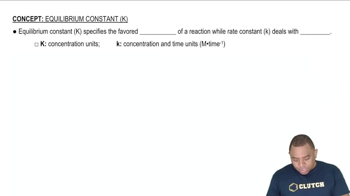
Equilibrium Constant (K)

The equilibrium constant (K) is a numerical value that expresses the ratio of the concentrations of products to reactants at equilibrium for a given reaction at a specific temperature. It is defined as K = [products]^[coefficients] / [reactants]^[coefficients]. A large K value indicates that products are favored at equilibrium, while a small K value suggests that reactants are favored.
Video consigliato:
Percorso guidato
01:14
Equilibrium Constant K

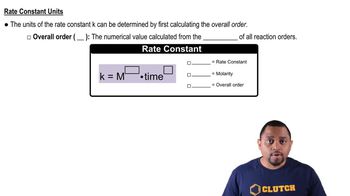
Forward and Reverse Rate Constants (kf and kr)

The forward rate constant (kf) and the reverse rate constant (kr) are parameters that describe the speed of the forward and reverse reactions, respectively. The relationship between these constants determines the position of equilibrium. If kf is much smaller than kr, the reaction favors the formation of reactants, leading to a higher concentration of reactants at equilibrium.
Video consigliato:
Percorso guidato
00:45
Rate Constant Units

Le Chatelier's Principle

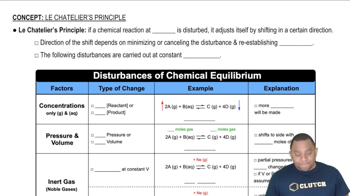
Le Chatelier's Principle states that if a system at equilibrium is subjected to a change in concentration, temperature, or pressure, the system will adjust to counteract that change and restore a new equilibrium. This principle helps predict how changes in conditions will affect the concentrations of reactants and products, providing insight into the behavior of the equilibrium mixture.
Video consigliato:
Percorso guidato
07:32
Le Chatelier's Principle