Ch.16 - Aqueous Equilibria: Acids & Bases
McMurry - Chemistry 8th Edition
McMurry8th EditionChemistryISBN: 9781292336145Non è quello che usi tu?Cambia libro di testo
Capitolo 16, Problema 17-143a

A 100.0 mL sample of a solution that is 0.100 M in HCl and 0.100 M in HCN is titrated with 0.100 M NaOH. Calculate the pH after the addition of the following volumes of NaOH:
(a) 0.0 mL

Guida verificata passo dopo passo
1
Step 1: Identify the species present in the solution before the titration begins. In this case, we have HCl, a strong acid, and HCN, a weak acid. The strong acid will completely ionize, while the weak acid will partially ionize.
Step 2: Calculate the initial concentrations of the species. The concentration of HCl is 0.100 M, and it will completely ionize to form H+ and Cl-. The concentration of HCN is also 0.100 M, but it will only partially ionize. Therefore, the initial concentration of H+ ions will be 0.100 M from the HCl, and a small additional amount from the HCN.
Step 3: Since no NaOH has been added yet, we don't need to consider any reactions with NaOH. The pH of the solution will be determined solely by the H+ concentration.
Step 4: Use the formula for pH, which is pH = -log[H+]. In this case, [H+] is the concentration of H+ ions in the solution.
Step 5: Substitute the value of [H+] into the pH formula to calculate the pH of the solution. Remember that the concentration of H+ ions is the sum of the ions from the HCl and the HCN.

Risposta video verificata per un problema simile:

Questa soluzione video è stata consigliata dai nostri tutor come utile per risolvere questo problema.
Durata del video:
3m

Concetti chiave

Ecco i concetti essenziali che devi comprendere per rispondere correttamente alla domanda.

Acid-Base Chemistry

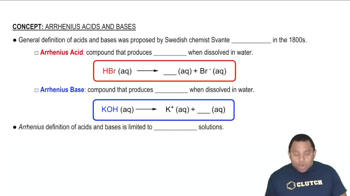
Acid-base chemistry involves the study of substances that can donate protons (acids) or accept protons (bases). In this context, HCl is a strong acid that completely dissociates in solution, while HCN is a weak acid that partially dissociates. Understanding the behavior of these acids in solution is crucial for predicting the pH changes during titration.
Video consigliato:
Percorso guidato
02:00
Arrhenius Acids and Bases

Titration

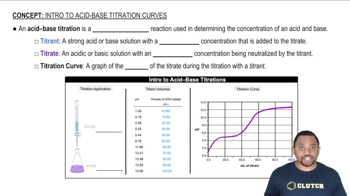
Titration is a quantitative analytical method used to determine the concentration of a solute in a solution. In this scenario, NaOH is added to the acid solution to neutralize it. The point at which the amount of titrant (NaOH) added is stoichiometrically equivalent to the amount of acid present is known as the equivalence point, which is essential for calculating pH at various stages of the titration.
Video consigliato:
Percorso guidato
03:04
Acid-Base Titration

pH Calculation

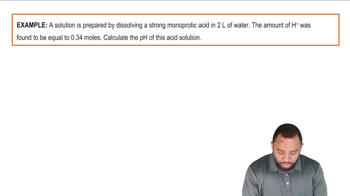
pH is a measure of the acidity or basicity of a solution, calculated as the negative logarithm of the hydrogen ion concentration. At the start of the titration (0.0 mL NaOH added), the pH is determined solely by the concentrations of HCl and HCN. Understanding how to calculate pH from the concentrations of acids and bases is vital for solving the problem presented.
Video consigliato:
Percorso guidato
02:15
pH Calculation Example