Ch.16 - Aqueous Equilibria: Acids & Bases
McMurry - Chemistry 8th Edition
McMurry8th EditionChemistryISBN: 9781292336145Non è quello che usi tu?Cambia libro di testo
Capitolo 16, Problema 155a

During a certain time period, 4.0 million tons of SO2 were released into the atmosphere and subsequently oxidized to SO3. As explained in the Inquiry, the acid rain produced when the SO3 dissolves in water can damage marble statues: CaCO3(s) + H2SO4(aq) → CaSO4(aq) + CO2(g) + H2O(l) (a) How many 500 pound marble statues could be damaged by the acid rain? (Assume that the statues are pure CaCO3 and that a statue is damaged when 3.0% of its mass is dissolved.)

Guida verificata passo dopo passo
1
Convert the mass of SO_2 released (4.0 million tons) to grams. Note that 1 ton = 2000 pounds and 1 pound = 453.592 grams.
Calculate the moles of SO_2 using its molar mass (64.07 g/mol).
Assume complete conversion of SO_2 to SO_3 and then to H_2SO_4. Use the stoichiometry of the reaction to find the moles of H_2SO_4 produced.
Determine the mass of CaCO_3 that can react with the produced H_2SO_4 using the stoichiometry of the reaction: CaCO_3(s) + H_2SO_4(aq) → CaSO_4(aq) + CO_2(g) + H_2O(l).
Calculate the number of 500-pound marble statues that could be damaged, knowing that 3.0% of each statue's mass is dissolved.

Risposta video verificata per un problema simile:

Questa soluzione video è stata consigliata dai nostri tutor come utile per risolvere questo problema.
Durata del video:
8m

Concetti chiave

Ecco i concetti essenziali che devi comprendere per rispondere correttamente alla domanda.

Stoichiometry

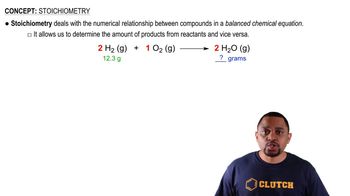
Stoichiometry is the calculation of reactants and products in chemical reactions based on the balanced chemical equation. It allows us to determine the amount of substances consumed and produced in a reaction, which is essential for solving problems involving mass and moles. In this question, stoichiometry will help calculate how much CaCO3 can be dissolved by the acid rain produced from the oxidation of SO2.
Video consigliato:
Percorso guidato
01:16
Stoichiometry Concept

Acid-Base Reactions

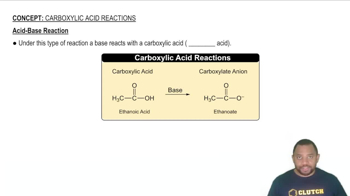
Acid-base reactions involve the transfer of protons (H+) between reactants, leading to the formation of water and salts. In this context, sulfuric acid (H2SO4) reacts with calcium carbonate (CaCO3) to produce calcium sulfate (CaSO4), carbon dioxide (CO2), and water (H2O). Understanding this reaction is crucial for determining how the acid rain affects marble statues, which are primarily composed of CaCO3.
Video consigliato:
Percorso guidato
01:09
Acid-Base Reaction

Mass Percent and Dissolution

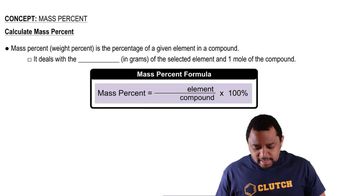
Mass percent is a way to express the concentration of a substance in a mixture, calculated as the mass of the solute divided by the total mass of the solution, multiplied by 100. In this problem, knowing that 3.0% of the marble statue's mass is dissolved helps to quantify the amount of CaCO3 that can be affected by the acid rain. This concept is key to determining how many statues can be damaged based on the total amount of acid produced.
Video consigliato:
Percorso guidato
00:38
Mass Percent Calculation
Pratica correlata
Domanda del libro di testo

A 1.000 L sample of HF gas at 20.0 °C and 0.601 atm pressure was dissolved in enough water to make 50.0 mL of hydrofluoric acid. (b) To what volume must you dilute the solution to triple the percent dissociation?

381
views

Domanda del libro di testo

A 1.000 L sample of HF gas at 20.0 °C and 0.601 atm pressure was dissolved in enough water to make 50.0 mL of hydrofluoric acid. (a) What is the pH of the solution?

272
views
Domanda del libro di testo
In aqueous solution, sodium acetate behaves as a strong electrolyte, yielding Na+ cations and CH3CO2 - anions. A particular solution of sodium acetate has a pH of 9.07 and a density of 1.0085 g/mL. What is the molality of this solution, and what is its freezing point?
1439
views
Domanda del libro di testo
In the case of very weak acids, 3H3O+ 4 from the dissociation of water is significant compared with 3H3O+ 4 from the dissociation of the weak acid. The sugar substitute saccharin 1C7H5NO3S2, for example, is a very weak acid having Ka = 2.1 * 10-12 and a solubility in water of 348 mg/100 mL. Calculate 3H3O+ 4 in a saturated solution of saccharin. (Hint: Equilibrium equations for the dissociation of saccharin and water must be solved simultaneously.)
437
views
Domanda del libro di testo
A 7.0 mass % solution of H3PO4 in water has a density of 1.0353 g/mL. Calculate the pH and the molar concentrations of all species present (H3PO4, H2PO4-, PO43-, H3O+ , and OH-) in the solution. Values of equilibrium constants are listed in Appendix C.
517
views
1
rank