Ch.16 - Aqueous Equilibria: Acids & Bases
McMurry - Chemistry 8th Edition
McMurry8th EditionChemistryISBN: 9781292336145Non è quello che usi tu?Cambia libro di testo
Capitolo 16, Problema 154

In aqueous solution, sodium acetate behaves as a strong electrolyte, yielding Na+ cations and CH3CO2 - anions. A particular solution of sodium acetate has a pH of 9.07 and a density of 1.0085 g/mL. What is the molality of this solution, and what is its freezing point?

Guida verificata passo dopo passo
1
Identify the dissociation of sodium acetate in water: \( \text{CH}_3\text{COONa} \rightarrow \text{Na}^+ + \text{CH}_3\text{COO}^- \).
Use the given pH to find the concentration of \( \text{OH}^- \) ions, since the solution is basic: \( \text{pH} + \text{pOH} = 14 \).
Calculate the concentration of \( \text{CH}_3\text{COO}^- \) using the equilibrium expression for the hydrolysis of acetate ions: \( \text{CH}_3\text{COO}^- + \text{H}_2\text{O} \rightleftharpoons \text{CH}_3\text{COOH} + \text{OH}^- \).
Determine the molality of the solution using the concentration of \( \text{CH}_3\text{COO}^- \) and the density of the solution to find the mass of the solvent.
Calculate the freezing point depression using the formula \( \Delta T_f = i \cdot K_f \cdot m \), where \( i \) is the van't Hoff factor, \( K_f \) is the cryoscopic constant, and \( m \) is the molality.

Risposta video verificata per un problema simile:

Questa soluzione video è stata consigliata dai nostri tutor come utile per risolvere questo problema.
Durata del video:
25m

Concetti chiave

Ecco i concetti essenziali che devi comprendere per rispondere correttamente alla domanda.

Electrolytes

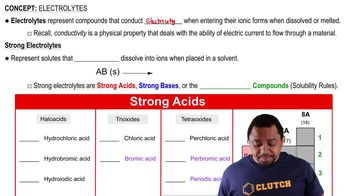
Electrolytes are substances that dissociate into ions when dissolved in water, allowing the solution to conduct electricity. Sodium acetate, a strong electrolyte, completely dissociates into sodium (Na+) and acetate (CH3CO2-) ions in solution. Understanding the behavior of electrolytes is crucial for calculating properties like pH and colligative effects, which are relevant to the freezing point of the solution.
Video consigliato:
Percorso guidato
02:50
Electrolytes and Strong Acids

pH and Acid-Base Chemistry

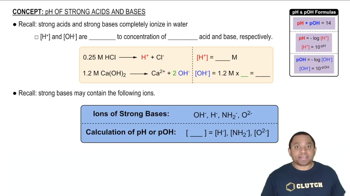
pH is a measure of the acidity or basicity of a solution, defined as the negative logarithm of the hydrogen ion concentration. A pH of 9.07 indicates a basic solution, which can affect the dissociation of weak acids and bases. In the case of sodium acetate, the acetate ion can act as a weak base, influencing the overall pH and the calculations related to the solution's properties.
Video consigliato:
Percorso guidato
02:39
pH of Strong Acids and Bases

Colligative Properties

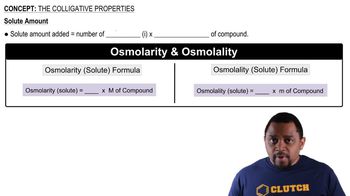
Colligative properties are physical properties of solutions that depend on the number of solute particles in a given amount of solvent, rather than the identity of the solute. These properties include boiling point elevation and freezing point depression. To determine the freezing point of the sodium acetate solution, one must calculate its molality, which is essential for applying the freezing point depression formula.
Video consigliato:
Percorso guidato
01:26
Colligative Properties
Pratica correlata
Domanda del libro di testo

A 1.000 L sample of HF gas at 20.0 °C and 0.601 atm pressure was dissolved in enough water to make 50.0 mL of hydrofluoric acid. (a) What is the pH of the solution?

272
views

Domanda del libro di testo

During a certain time period, 4.0 million tons of SO2 were released into the atmosphere and subsequently oxidized to SO3. As explained in the Inquiry, the acid rain produced when the SO3 dissolves in water can damage marble statues: CaCO3(s) + H2SO4(aq) → CaSO4(aq) + CO2(g) + H2O(l) (a) How many 500 pound marble statues could be damaged by the acid rain? (Assume that the statues are pure CaCO3 and that a statue is damaged when 3.0% of its mass is dissolved.)

357
views
Domanda del libro di testo
Acid and base behavior can be observed in solvents other than water. One commonly used solvent is dimethyl sulfoxide (DMSO), which can be treated as a monoprotic acid 'HSol.' Just as water can behave either as an acid or a base, so HSol can behave either as a Brønsted–Lowry acid or base. (b) The weak acid HCN has an acid dissociation constant Ka = 1.3 * 10-13 in the solvent HSol. If 0.010 mol of NaCN is dissolved in 1.00 L of HSol, what is the equilibrium concentration of H2Sol + ?
922
views
Domanda del libro di testo
In the case of very weak acids, 3H3O+ 4 from the dissociation of water is significant compared with 3H3O+ 4 from the dissociation of the weak acid. The sugar substitute saccharin 1C7H5NO3S2, for example, is a very weak acid having Ka = 2.1 * 10-12 and a solubility in water of 348 mg/100 mL. Calculate 3H3O+ 4 in a saturated solution of saccharin. (Hint: Equilibrium equations for the dissociation of saccharin and water must be solved simultaneously.)
437
views
Domanda del libro di testo
A 7.0 mass % solution of H3PO4 in water has a density of 1.0353 g/mL. Calculate the pH and the molar concentrations of all species present (H3PO4, H2PO4-, PO43-, H3O+ , and OH-) in the solution. Values of equilibrium constants are listed in Appendix C.
517
views
1
rank