
Ch.16 - Aqueous Equilibria: Acids & Bases
McMurry - Chemistry 8th Edition
McMurry8th EditionChemistryISBN: 9781292336145Non è quello che usi tu?Cambia libro di testo
Capitolo 16, Problema 148

Normal rain has a pH of 5.6 due to dissolved atmospheric carbon dioxide at a current level of 400 ppm. Various models predict that burning fossil fuels will increase the atmospheric CO2 concentration to between 500 and 1000 ppm by the year 2100. (a) Calculate the pH of rain in a scenario where the CO2 concentration is 750 ppm. CO2 reacts with water to produce carbonic acid according to the equation: CO2(aq) + H2O(l) ⇌ H2CO3(aq). Assume all the dissolved CO2 is converted to H2CO3. Acid dissociation constants for H2CO3 are Ka1 = 4.3 * 10^-7; Ka2 = 5.6 * 10^-11. (Worked Example 16.11 is a model for this calculation.) (b) Will rising CO2 levels affect the acidity of rainfall?

Guida verificata passo dopo passo
1
Step 1: Understand the chemical equilibrium involved. CO2 dissolves in water to form carbonic acid (H2CO3), which can dissociate into H+ ions and bicarbonate (HCO3-) ions. The relevant reactions are: CO2(aq) + H2O(l) ⇌ H2CO3(aq) and H2CO3(aq) ⇌ H+(aq) + HCO3-(aq).
Step 2: Calculate the concentration of dissolved CO2. Use the given ppm value to find the molarity of CO2 in water. Assume the density of water is approximately 1 g/mL, which means 1 L of water weighs 1000 g. Convert ppm to molarity using the formula: Molarity (M) = (ppm * 10^-6) / molar mass of CO2.
Step 3: Assume all dissolved CO2 is converted to H2CO3. Use the calculated molarity of CO2 as the initial concentration of H2CO3. Set up an ICE (Initial, Change, Equilibrium) table to track the changes in concentration as H2CO3 dissociates.
Step 4: Apply the acid dissociation constant (Ka1) for the first dissociation of H2CO3. Use the expression Ka1 = [H+][HCO3-] / [H2CO3] to solve for the concentration of H+ ions at equilibrium. Assume [H+] = [HCO3-] and [H2CO3] = initial concentration - [H+].
Step 5: Calculate the pH of the solution. Use the formula pH = -log[H+] to find the pH of the rainwater under the given CO2 concentration. Discuss how an increase in CO2 concentration affects the acidity of rainfall, noting that higher [H+] results in a lower pH, indicating increased acidity.

Concetti chiave

Ecco i concetti essenziali che devi comprendere per rispondere correttamente alla domanda.

pH and Acidity

pH is a measure of the hydrogen ion concentration in a solution, indicating its acidity or basicity. A lower pH value corresponds to higher acidity, while a higher pH indicates a more basic solution. Normal rain has a pH of about 5.6, which is slightly acidic due to dissolved carbon dioxide forming carbonic acid. Understanding pH is crucial for predicting how changes in CO2 levels will affect the acidity of rain.
Video consigliato:
Percorso guidato
02:39
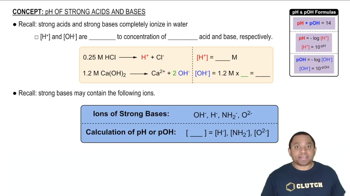
pH of Strong Acids and Bases

Carbon Dioxide and Carbonic Acid Formation

When carbon dioxide (CO2) dissolves in water, it reacts to form carbonic acid (H2CO3) through the equation CO2(aq) + H2O(l) ⇌ H2CO3(aq). This reaction is essential for understanding the chemistry of rainwater, as increased CO2 levels lead to more carbonic acid formation, which in turn lowers the pH of rainwater. This concept is fundamental for calculating the expected pH changes with varying CO2 concentrations.
Video consigliato:
Percorso guidato
03:48
3 and 4 Carbon Alkyls

Acid Dissociation Constants (Ka)

The acid dissociation constants (Ka) quantify the strength of an acid in solution, indicating how readily it donates protons (H+) to the solution. For carbonic acid, there are two dissociation steps, represented by Ka1 and Ka2. These constants are critical for calculating the pH of a solution containing carbonic acid, as they help determine the equilibrium concentrations of the species involved in the dissociation reactions.
Video consigliato:
Percorso guidato
03:50
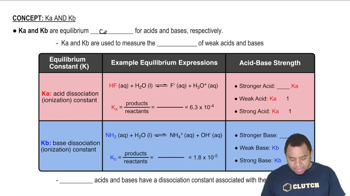
Characteristics of Ka and Kb
Pratica correlata
Domanda del libro di testo
When NO2 is bubbled into water, it is completely converted to HNO3 and HNO2: 2 NO21g2 + H2O1l2S HNO31aq2 + HNO21aq2 Calculate the pH and the concentrations of all species present (H3O+ , OH-, HNO2, NO2 -, and NO3 -) in a solution prepared by dissolving 0.0500 mol of NO2 in 1.00 L of water. Ka for HNO2 is 4.5 * 10-4.
973
views
Domanda del libro di testo
Which would you expect to be the stronger Lewis acid in each of the following pairs? Explain. (a) BF3 or BH3
541
views
Domanda del libro di testo
Acid and base behavior can be observed in solvents other than water. One commonly used solvent is dimethyl sulfoxide (DMSO), which can be treated as a monoprotic acid 'HSol.' Just as water can behave either as an acid or a base, so HSol can behave either as a Brønsted–Lowry acid or base. (b) The weak acid HCN has an acid dissociation constant Ka = 1.3 * 10-13 in the solvent HSol. If 0.010 mol of NaCN is dissolved in 1.00 L of HSol, what is the equilibrium concentration of H2Sol + ?
922
views
Domanda del libro di testo
Calculate the pH and the concentrations of all species present (H3O+ , F-, HF, Cl-, and OH-) in a solution that contains 0.10 M HF 1Ka = 3.5 * 10-42 and 0.10 M HCl.
737
views
Domanda del libro di testo
A 7.0 mass % solution of H3PO4 in water has a density of 1.0353 g/mL. Calculate the pH and the molar concentrations of all species present (H3PO4, H2PO4-, PO43-, H3O+ , and OH-) in the solution. Values of equilibrium constants are listed in Appendix C.
517
views
1
rank