Ch.17 - Applications of Aqueous Equilibria
McMurry - Chemistry 8th Edition
McMurry8th EditionChemistryISBN: 9781292336145Non è quello che usi tu?Cambia libro di testo
Capitolo 17, Problema 148f

A 40.0 mL sample of a mixture of HCl and H3PO4 was titrated with 0.100 M NaOH. The first equivalence point was reached after 88.0 mL of base, and the second equivalence point was reached after 126.4 mL of base. (f) What indicators would you select to signal the equivalence points?

Guida verificata passo dopo passo
1
Step 1: Understand the titration process. In this problem, you are dealing with a mixture of HCl (a strong acid) and H3PO4 (a triprotic acid). The titration with NaOH will have multiple equivalence points due to the different acidic protons being neutralized.
Step 2: Identify the equivalence points. The first equivalence point corresponds to the complete neutralization of HCl and the first proton of H3PO4. The second equivalence point corresponds to the neutralization of the second proton of H3PO4.
Step 3: Choose an indicator for the first equivalence point. Since the first equivalence point involves the neutralization of a strong acid (HCl) and the first proton of a weak acid (H3PO4), the pH at this point will be slightly acidic. An indicator like methyl orange, which changes color in the pH range of 3.1 to 4.4, would be suitable.
Step 4: Choose an indicator for the second equivalence point. The second equivalence point involves the neutralization of the second proton of H3PO4, which is a weak acid. The pH at this point will be more neutral. An indicator like phenolphthalein, which changes color in the pH range of 8.2 to 10.0, would be appropriate.
Step 5: Consider the pH range of the indicators. Ensure that the chosen indicators have a color change range that encompasses the expected pH at each equivalence point to accurately signal the completion of each stage of the titration.

Risposta video verificata per un problema simile:

Questa soluzione video è stata consigliata dai nostri tutor come utile per risolvere questo problema.
Durata del video:
4m

Concetti chiave

Ecco i concetti essenziali che devi comprendere per rispondere correttamente alla domanda.

Titration and Equivalence Points

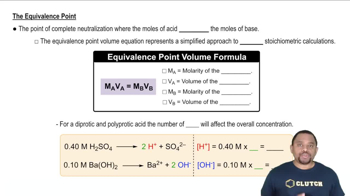
Titration is a quantitative analytical method used to determine the concentration of a solute in a solution. The equivalence point in a titration occurs when the amount of titrant added is stoichiometrically equivalent to the amount of substance being titrated. In this case, the first and second equivalence points indicate the complete neutralization of HCl and H3PO4, respectively, by NaOH.
Video consigliato:
Percorso guidato
03:06
Equivalence Point in Titration

Indicators in Titration

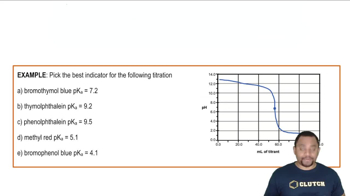
Indicators are substances that change color at a specific pH range, signaling the completion of a titration. The choice of indicator depends on the pH at the equivalence point of the titration. For strong acid-strong base titrations, phenolphthalein is commonly used, while for weak acid-strong base titrations, methyl orange or bromothymol blue may be more appropriate.
Video consigliato:
Percorso guidato
00:52
Best Indicator Example

Acid-Base Strength and pH

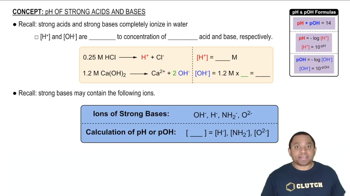
The strength of an acid or base affects the pH at the equivalence point. Strong acids like HCl fully dissociate in solution, while weak acids like H3PO4 do not. This difference means that the pH at the equivalence point for HCl will be around 7, while for H3PO4, it will be lower than 7, necessitating the use of different indicators to accurately signal the equivalence points.
Video consigliato:
Percorso guidato
02:39
pH of Strong Acids and Bases