Ch.17 - Applications of Aqueous Equilibria
McMurry - Chemistry 8th Edition
McMurry8th EditionChemistryISBN: 9781292336145Non è quello che usi tu?Cambia libro di testo
Capitolo 17, Problema 148c

A 40.0 mL sample of a mixture of HCl and H3PO4 was titrated with 0.100 M NaOH. The first equivalence point was reached after 88.0 mL of base, and the second equivalence point was reached after 126.4 mL of base. (c) What percent of the HCl is neutralized at the first equivalence point?

Guida verificata passo dopo passo
1
First, understand that the first equivalence point in a titration is when all of the acid in the solution has been neutralized by the base. In this case, the first equivalence point was reached after 88.0 mL of NaOH was added, meaning all of the HCl was neutralized.
Next, calculate the moles of NaOH used to reach the first equivalence point. This can be done using the formula: moles = Molarity * Volume. The molarity of NaOH is given as 0.100 M and the volume used to reach the first equivalence point is 88.0 mL (or 0.088 L).
Since HCl and NaOH react in a 1:1 ratio, the moles of NaOH used to reach the first equivalence point is equal to the moles of HCl in the original solution.
Then, calculate the molarity of HCl in the original solution using the formula: Molarity = moles / Volume. The volume of the original solution is given as 40.0 mL (or 0.040 L).
Finally, to find the percent of HCl neutralized at the first equivalence point, understand that 100% of the HCl is neutralized at this point. This is because the definition of the equivalence point is when all of the acid (in this case, HCl) has been neutralized by the base (NaOH).

Risposta video verificata per un problema simile:

Questa soluzione video è stata consigliata dai nostri tutor come utile per risolvere questo problema.
Durata del video:
2m

Concetti chiave

Ecco i concetti essenziali che devi comprendere per rispondere correttamente alla domanda.

Titration and Equivalence Points

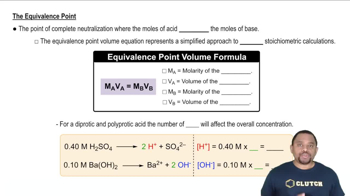
Titration is a quantitative analytical method used to determine the concentration of a solute in a solution. The equivalence point in a titration is reached when the amount of titrant added is stoichiometrically equivalent to the amount of substance in the sample. In this case, the first equivalence point indicates the complete neutralization of HCl, while the second equivalence point involves the neutralization of H3PO4.
Video consigliato:
Percorso guidato
03:06
Equivalence Point in Titration

Stoichiometry of Acid-Base Reactions

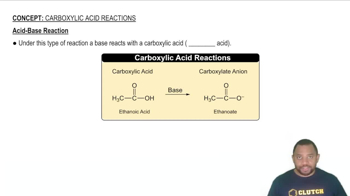
Stoichiometry involves the calculation of reactants and products in chemical reactions based on balanced equations. For the titration of HCl with NaOH, the reaction is a 1:1 ratio, meaning one mole of HCl reacts with one mole of NaOH. Understanding this ratio is crucial for determining how much HCl is neutralized at the first equivalence point.
Video consigliato:
Percorso guidato
01:09
Acid-Base Reaction

Concentration and Volume Relationships

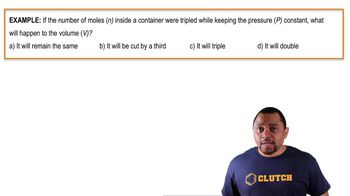
The relationship between concentration and volume is essential in titration calculations. The formula C1V1 = C2V2 relates the concentrations and volumes of the acid and base involved. By knowing the concentration of NaOH and the volume used to reach the first equivalence point, one can calculate the moles of HCl neutralized and subsequently determine the percentage of HCl in the original mixture.
Video consigliato:
Percorso guidato
01:09
Relationship of Volume and Moles Example