Ch.17 - Applications of Aqueous Equilibria
McMurry - Chemistry 8th Edition
McMurry8th EditionChemistryISBN: 9781292336145Non è quello che usi tu?Cambia libro di testo
Capitolo 17, Problema 79

Consider a buffer solution that contains equal concentrations of H2PO4- and HPO42-. Will the pH increase, decrease, or remain the same when each of the following substances is added? (a) Na2HPO4 (b) HBr (c) KOH (d) KI (e) H3PO4 (f) Na3PO4

Guida verificata passo dopo passo
1
1. Understand that a buffer solution is a solution that can resist pH change upon the addition of an acidic or basic component. It is able to neutralize small amounts of added acid or base, thus maintaining the pH of the solution relatively stable. This is achieved by having a weak acid and its conjugate base (or a weak base and its conjugate acid) in the solution.
2. Recognize that H2PO4- and HPO42- are a conjugate acid-base pair. The H2PO4- can donate a proton (H+) to the solution, acting as an acid, while the HPO42- can accept a proton, acting as a base.
3. For each substance added, determine whether it will donate or accept protons in the solution. (a) Na2HPO4 will dissociate into Na+ and HPO42-. The HPO42- can accept a proton, thus it will act as a base and increase the pH. (b) HBr will dissociate into H+ and Br-. The H+ will increase the acidity of the solution, thus decreasing the pH. (c) KOH will dissociate into K+ and OH-. The OH- will react with H+ in the solution, decreasing the acidity and increasing the pH. (d) KI will dissociate into K+ and I-, but neither ion will affect the pH. (e) H3PO4 will donate protons to the solution, increasing the acidity and decreasing the pH. (f) Na3PO4 will dissociate into Na+ and PO43-. The PO43- can accept protons, thus it will act as a base and increase the pH.
4. Remember that the buffer solution will resist changes in pH, so the changes will be less than if these substances were added to water.
5. Finally, always consider the relative amounts of the substances added and the buffer components. If a large amount of a strong acid or base is added, the buffer capacity may be exceeded, resulting in a significant pH change.

Risposta video verificata per un problema simile:

Questa soluzione video è stata consigliata dai nostri tutor come utile per risolvere questo problema.
Durata del video:
12m

Concetti chiave

Ecco i concetti essenziali che devi comprendere per rispondere correttamente alla domanda.

Buffer Solutions

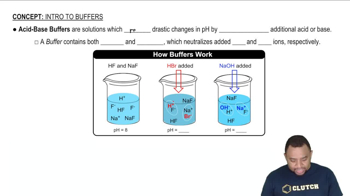
A buffer solution is a system that resists changes in pH upon the addition of small amounts of acids or bases. It typically consists of a weak acid and its conjugate base, or a weak base and its conjugate acid. In this case, the buffer is made up of H2PO4- (dihydrogen phosphate) and HPO42- (hydrogen phosphate), which can neutralize added acids or bases to maintain a relatively stable pH.
Video consigliato:
Percorso guidato
03:02
Buffer Solutions

Henderson-Hasselbalch Equation

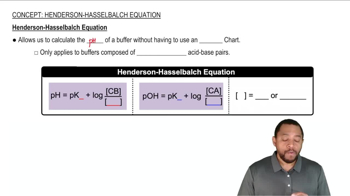
The Henderson-Hasselbalch equation relates the pH of a buffer solution to the concentration of its acid and conjugate base. It is expressed as pH = pKa + log([A-]/[HA]), where [A-] is the concentration of the base and [HA] is the concentration of the acid. This equation helps predict how the pH will change when acids or bases are added to the buffer system.
Video consigliato:
Percorso guidato
02:40
Henderson-Hasselbalch Equation

Acid-Base Reactions

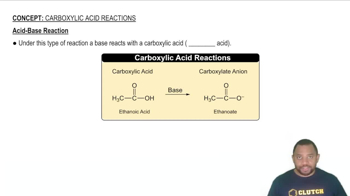
Acid-base reactions involve the transfer of protons (H+) between species. Strong acids, like HBr, will dissociate completely in solution, increasing the concentration of H+ ions and lowering the pH. Conversely, strong bases, like KOH, will increase the concentration of OH- ions, which can raise the pH by neutralizing H+ ions. Understanding these reactions is crucial for predicting the pH changes in buffer solutions.
Video consigliato:
Percorso guidato
01:09
Acid-Base Reaction