Which of the following compounds are more soluble in acidic solution than in pure water? Write a balanced net ionic equation for each dissolution reaction. (b) Fe(OH)3
Ch.17 - Applications of Aqueous Equilibria
Capitolo 17, Problema 116
Consider saturated solutions of the slightly soluble salt BaCO3. Is the solubility of BaCO3 increased, decreased, or unaffected by the addition of each of the following substances? (a) HNO3 (b) Ba(NO3)2 (c) Na2CO3 (d) CH3CO2H
Guida verificata passo dopo passo1
Step 1: Understand the concept of solubility and the common ion effect. Solubility refers to the ability of a substance to dissolve in a solvent. The common ion effect states that the solubility of a salt is decreased when a solution already contains one of the ions present in the salt.
Step 2: Analyze the effect of adding HNO3. HNO3 is a strong acid that dissociates completely in water, increasing the concentration of H+ ions. The presence of H+ ions can react with CO3^2- ions to form H2CO3, which can decompose into CO2 and H2O, thus increasing the solubility of BaCO3 by removing CO3^2- ions from the solution.
Step 3: Analyze the effect of adding Ba(NO3)2. Ba(NO3)2 dissociates into Ba^2+ and NO3^- ions. The addition of Ba^2+ ions increases the concentration of a common ion, which decreases the solubility of BaCO3 due to the common ion effect.
Step 4: Analyze the effect of adding Na2CO3. Na2CO3 dissociates into Na+ and CO3^2- ions. The addition of CO3^2- ions increases the concentration of a common ion, which decreases the solubility of BaCO3 due to the common ion effect.
Step 5: Analyze the effect of adding CH3CO2H (acetic acid). CH3CO2H is a weak acid that partially dissociates in water, increasing the concentration of H+ ions. Similar to HNO3, the H+ ions can react with CO3^2- ions to form H2CO3, thus increasing the solubility of BaCO3 by removing CO3^2- ions from the solution.
Concetti chiave
Ecco i concetti essenziali che devi comprendere per rispondere correttamente alla domanda.
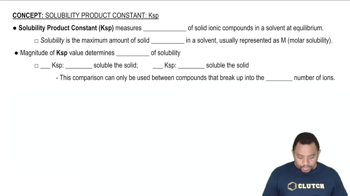
Solubility Product Constant (Ksp)
The solubility product constant (Ksp) is an equilibrium constant that applies to the solubility of sparingly soluble ionic compounds. It is defined as the product of the molar concentrations of the ions, each raised to the power of their coefficients in the balanced equation. For BaCO3, Ksp helps determine how changes in concentration of ions affect its solubility in solution.
Video consigliato:
Percorso guidato
Solubility Product Constant
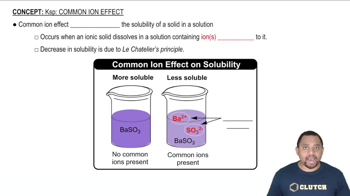
Common Ion Effect
The common ion effect refers to the decrease in solubility of a salt when a common ion is added to the solution. This occurs because the addition of the common ion shifts the equilibrium position according to Le Chatelier's principle, reducing the solubility of the salt. For example, adding Ba(NO3)2 introduces Ba²⁺ ions, which would decrease the solubility of BaCO3.
Video consigliato:
Percorso guidato
Common Ion Effect
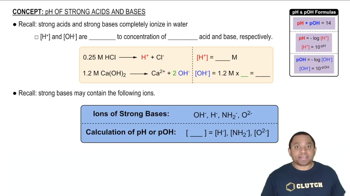
Acid-Base Reactions and pH
The pH of a solution can significantly influence the solubility of certain salts, particularly those containing basic anions like CO3²⁻. When an acid, such as HNO3, is added, it reacts with CO3²⁻ to form HCO3⁻ or H2CO3, effectively removing CO3²⁻ from the solution. This shift can increase the solubility of BaCO3 by reducing the concentration of the carbonate ion.
Video consigliato:
Percorso guidato
pH of Strong Acids and Bases
Pratica correlata
Domanda del libro di testo
639
views
Domanda del libro di testo
Is the solubility of Zn(OH)2 increased, decreased, or unchanged on addition of each of the following substances? Write a balanced net ionic equation for each dissolution reaction. (See Appendix C.6 for formulas of complex ions.) (a) HCl
702
views
Domanda del libro di testo
Is the solubility of Zn(OH)2 increased, decreased, or unchanged on addition of each of the following substances? Write a balanced net ionic equation for each dissolution reaction. (See Appendix C.6 for formulas of complex ions.) (c) NaCN
621
views
Domanda del libro di testo
Is the solubility of Zn(OH)2 increased, decreased, or unchanged on addition of each of the following substances? Write a balanced net ionic equation for each dissolution reaction. (See Appendix C.6 for formulas of complex ions.) (b) KOH