
Ch.18 - Thermodynamics: Entropy, Free Energy & Equilibrium
McMurry - Chemistry 8th Edition
McMurry8th EditionChemistryISBN: 9781292336145Non è quello che usi tu?Cambia libro di testo
Capitolo 18, Problema 40

Assuming that gaseous reactants and products are present at 1 atm partial pressure, which of the following reactions are spontaneous in the forward direction? (a) (b) (c) (d)

Guida verificata passo dopo passo
1
insert step 1: Identify the reactions and their respective Gibbs free energy changes (ΔG) if provided.
insert step 2: Recall that a reaction is spontaneous in the forward direction if ΔG is negative.
insert step 3: If ΔG is not provided, consider using the equation ΔG = ΔH - TΔS, where ΔH is the change in enthalpy, T is the temperature in Kelvin, and ΔS is the change in entropy.
insert step 4: Evaluate the sign of ΔG for each reaction. If ΔG is negative, the reaction is spontaneous in the forward direction.
insert step 5: Conclude which reactions are spontaneous based on the sign of ΔG for each reaction.

Risposta video verificata per un problema simile:

Questa soluzione video è stata consigliata dai nostri tutor come utile per risolvere questo problema.
Durata del video:
2m

Concetti chiave

Ecco i concetti essenziali che devi comprendere per rispondere correttamente alla domanda.

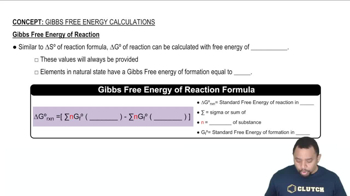
Gibbs Free Energy

Gibbs Free Energy (G) is a thermodynamic potential that helps predict the spontaneity of a reaction at constant temperature and pressure. A reaction is spontaneous in the forward direction if the change in Gibbs Free Energy (ΔG) is negative. This concept is crucial for determining whether a reaction will occur without external input.
Video consigliato:
Percorso guidato
01:51
Gibbs Free Energy of Reactions

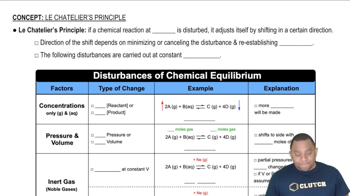
Le Chatelier's Principle

Le Chatelier's Principle states that if a dynamic equilibrium is disturbed by changing the conditions, the system shifts in a direction that counteracts the change. This principle is important for understanding how changes in pressure, temperature, or concentration can affect the spontaneity of reactions involving gaseous reactants and products.
Video consigliato:
Percorso guidato
07:32
Le Chatelier's Principle

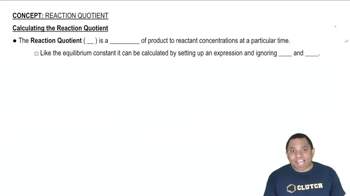
Reaction Quotient (Q) and Equilibrium Constant (K)

The Reaction Quotient (Q) is a measure of the relative concentrations of reactants and products at any point in a reaction, while the Equilibrium Constant (K) describes the ratio at equilibrium. Comparing Q to K helps determine the direction of spontaneity: if Q < K, the reaction proceeds forward; if Q > K, it shifts backward. This concept is essential for analyzing the spontaneity of reactions under given conditions.
Video consigliato:
Percorso guidato
00:49
Reaction Quotient Q