
Ch.18 - Thermodynamics: Entropy, Free Energy & Equilibrium
McMurry - Chemistry 8th Edition
McMurry8th EditionChemistryISBN: 9781292336145Non è quello che usi tu?Cambia libro di testo
Capitolo 18, Problema 42

Define entropy, and give an example of a process in which the entropy of a system increases.

Guida verificata passo dopo passo
1
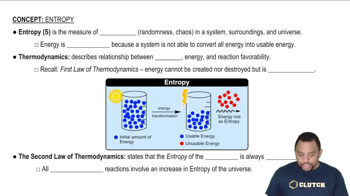
Entropy is a measure of the disorder or randomness in a system. It is a thermodynamic quantity that is often associated with the number of microscopic configurations that correspond to a thermodynamic system's macroscopic state.
In thermodynamics, the second law states that the total entropy of an isolated system can never decrease over time. It can remain constant in ideal cases where the system is in a steady state or undergoing a reversible process.
An example of a process in which the entropy of a system increases is the melting of ice into water. In this process, the structured, orderly arrangement of water molecules in the solid state (ice) becomes more disordered as the molecules move more freely in the liquid state (water).
Another example is the mixing of two gases. When two different gases are allowed to mix, the entropy increases because the molecules of the gases become more randomly distributed throughout the available volume.
In both examples, the increase in entropy reflects the greater number of possible arrangements or configurations of the molecules in the system, leading to a higher degree of disorder.

Risposta video verificata per un problema simile:

Questa soluzione video è stata consigliata dai nostri tutor come utile per risolvere questo problema.
Durata del video:
3m

Concetti chiave

Ecco i concetti essenziali che devi comprendere per rispondere correttamente alla domanda.

Entropy

Entropy is a measure of the disorder or randomness in a system. In thermodynamics, it quantifies the number of microscopic configurations that correspond to a thermodynamic system's macroscopic state. Higher entropy indicates greater disorder and less energy available for doing work, reflecting the second law of thermodynamics, which states that the total entropy of an isolated system can never decrease over time.
Video consigliato:
Percorso guidato
02:46
Entropy in Thermodynamics

Second Law of Thermodynamics

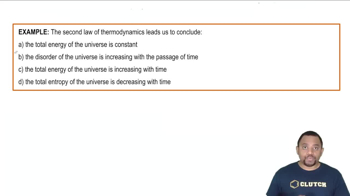
The second law of thermodynamics states that in any energy transfer or transformation, the total entropy of an isolated system will always increase over time. This principle implies that natural processes tend to move towards a state of greater disorder or randomness. It explains why certain processes, such as heat transfer from hot to cold objects, occur spontaneously, leading to an increase in the overall entropy of the universe.
Video consigliato:
Percorso guidato
00:48
Second Law of Thermodynamics Example

Example of Increasing Entropy

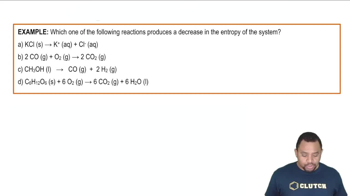
An example of a process in which entropy increases is the melting of ice into water. When ice melts, the structured arrangement of water molecules in the solid state becomes more disordered in the liquid state. This transition from a solid to a liquid increases the entropy of the system, as the molecules have more freedom to move and occupy a greater number of configurations.
Video consigliato:
Percorso guidato
01:15
Entropy and Chemical Changes Example