
Ch.18 - Thermodynamics: Entropy, Free Energy & Equilibrium
McMurry - Chemistry 8th Edition
McMurry8th EditionChemistryISBN: 9781292336145Non è quello che usi tu?Cambia libro di testo
Capitolo 18, Problema 50

Consider the distribution of ideal gas molecules among three bulbs (A, B, and C) of equal volume. For each of the follow-ing states, determine the number of ways (W) that the state can be achieved, and use Boltzmann's equation to calculate the entropy of the state. (a) 2 molecules in bulb A (b) 2 molecules randomly distributed among bulbs A, B, and C

Guida verificata passo dopo passo
1
Identify the total number of molecules and the number of bulbs. In this case, there are 2 molecules and 3 bulbs (A, B, and C).
For part (a), where 2 molecules are in bulb A, calculate the number of ways (W) this can be achieved. Since both molecules are in one bulb, there is only one way to arrange this, so W = 1.
Use Boltzmann's equation to calculate the entropy (S) for part (a). The equation is S = k \(\ln\)(W), where k is the Boltzmann constant. Plug in W = 1 to find S.
For part (b), where 2 molecules are randomly distributed among the three bulbs, calculate the number of ways (W) this can be achieved. Consider each molecule can be in any of the three bulbs independently, so the total number of arrangements is 3 choices for the first molecule multiplied by 3 choices for the second molecule, giving W = 3^2 = 9.
Use Boltzmann's equation again to calculate the entropy (S) for part (b). Plug in W = 9 into the equation S = k \(\ln\)(W) to find the entropy for this distribution.

Risposta video verificata per un problema simile:

Questa soluzione video è stata consigliata dai nostri tutor come utile per risolvere questo problema.
Durata del video:
4m

Concetti chiave

Ecco i concetti essenziali che devi comprendere per rispondere correttamente alla domanda.

Boltzmann's Equation

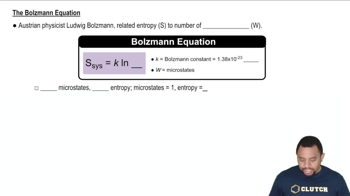
Boltzmann's equation relates the entropy (S) of a system to the number of microstates (W) that correspond to a given macrostate. It is expressed as S = k * ln(W), where k is the Boltzmann constant. This equation highlights the connection between the microscopic behavior of particles and the macroscopic property of entropy, emphasizing that greater disorder (more microstates) leads to higher entropy.
Video consigliato:
Percorso guidato
01:23
The Boltzmann Equation

Microstates and Macrostates

In statistical mechanics, a microstate refers to a specific arrangement of particles in a system, while a macrostate is defined by macroscopic properties like temperature and pressure. The number of microstates corresponding to a macrostate determines the entropy of that state. Understanding how to count microstates is crucial for calculating the entropy of different distributions of gas molecules.
Video consigliato:
Percorso guidato
01:23
The Boltzmann Equation

Combinatorial Counting

Combinatorial counting is a mathematical technique used to determine the number of ways to arrange or distribute objects. In the context of gas molecules in bulbs, it involves calculating the different ways to distribute a set number of molecules across multiple containers. This concept is essential for finding the number of microstates (W) for each scenario, which is then used in Boltzmann's equation to find the entropy.
Video consigliato:
Percorso guidato
01:09
Significant Figures Example