Ch.18 - Thermodynamics: Entropy, Free Energy & Equilibrium
McMurry - Chemistry 8th Edition
McMurry8th EditionChemistryISBN: 9781292336145Non è quello che usi tu?Cambia libro di testo
Capitolo 18, Problema 16

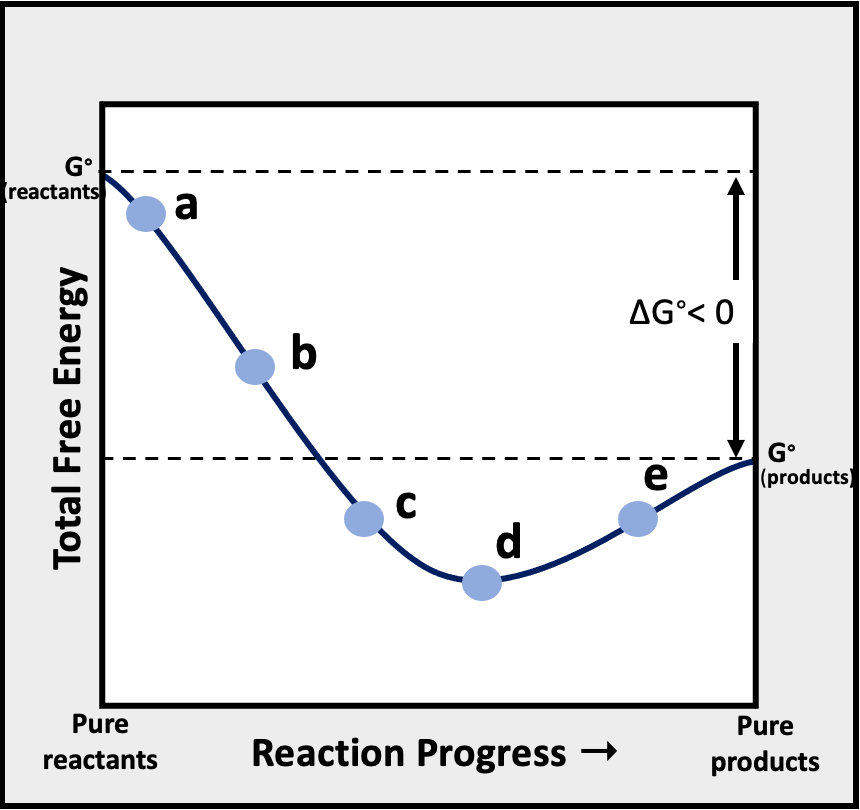
Consider the following graph of total free energy of reactants and products versus reaction progress for the general reaction, Reactants -> Products. At which of the four points (labeled a, b, c, and d) is Q < K? Graph showing total free energy vs reaction progress with points a, b, c, d labeled.
(a) Point a (b) Point c and d (c) Point a, c, and d (d) Point b

Guida verificata passo dopo passo
1
Identify the points on the graph where the reaction is not at equilibrium. These points are where the reaction quotient Q is not equal to the equilibrium constant K.
Understand that at equilibrium, Q = K, and the system is at its lowest free energy state.
Recognize that points a, b, c, and d are not at equilibrium because they are not at the lowest free energy state (point e).
Determine the direction of the reaction progress. If the reaction proceeds towards products, Q < K; if it proceeds towards reactants, Q > K.
Since points a, c, and d are on the path towards the products (lower free energy), Q < K at these points.

Risposta video verificata per un problema simile:

Questa soluzione video è stata consigliata dai nostri tutor come utile per risolvere questo problema.
Durata del video:
2m

Concetti chiave

Ecco i concetti essenziali che devi comprendere per rispondere correttamente alla domanda.

Gibbs Free Energy (G)

Gibbs Free Energy is a thermodynamic potential that measures the maximum reversible work obtainable from a thermodynamic system at constant temperature and pressure. It is a crucial factor in determining the spontaneity of a reaction; if the change in Gibbs Free Energy (ΔG) is negative, the reaction is spontaneous in the forward direction.
Video consigliato:
Percorso guidato
01:51
Gibbs Free Energy of Reactions

Reaction Quotient (Q) and Equilibrium Constant (K)

The reaction quotient (Q) is a measure of the relative concentrations of products and reactants at any point in a reaction, while the equilibrium constant (K) is the value of Q when the reaction is at equilibrium. When Q < K, it indicates that the reaction will proceed in the forward direction to reach equilibrium, favoring the formation of products.
Video consigliato:
Percorso guidato
00:49
Reaction Quotient Q

Free Energy Diagram

A free energy diagram visually represents the change in Gibbs Free Energy as a reaction progresses from reactants to products. It typically shows the energy levels of reactants and products, along with transition states, and helps identify points of interest, such as where Q is less than K, indicating the direction in which the reaction will favorably proceed.
Video consigliato:
Percorso guidato
01:57
Energy Diagrams
Pratica correlata
Domanda del libro di testo
Consider the gas-phase reaction of AB3 and A2 molecules:

(a) Write a balanced equation for the reaction. (b) What is the sign of the entropy change for the reaction?
797
views

Domanda del libro di testo
Ammonium hydrogen sulfide, a stink bomb ingredient, decomposes to ammonia and hydrogen sulfide: Calculate the standard free-energy change for the rection at 25 °C if the total pressure resulting from the solid NH4S placed in an evacuated container is 0.658 atm at 25 °C. (a) -43.8 kJ (b) +1.04 kJ (c) -462 kJ (d) +5.51 kJ
464
views
Domanda del libro di testo

Formation constants for the ammonia and ethylenediamine complexes of nickel(II) indicate that Ni(en)32+ is much more

stable than Ni(NH3)62+:

(1) <REACTION>

(2) <REACTION>

The enthalpy changes for the two reactions, ΔH°1 and ΔH°2, should be about the same because both complexes have six Ni﹣N bonds. 

(c) Assuming that ΔH°2 - ΔH°1 is zero, calculate the value of ΔS°2 - ΔS°1.

100
views
Domanda del libro di testo

Spinach contains a lot of iron but is not a good source of dietary iron because nearly all the iron is tied up in the oxalate complex [Fe(C2O4)3]3-.

(b) Under the acidic conditions in the stomach, the Fe3+ concentration should be greater because of the reaction

[Fe(C2O4)3]3-(aq) + 6 H3O+(aq) ⇌ Fe3+(aq) + 3 H2C2O4(aq) + 6 H2O(l)

Show, however, that this reaction is nonspontaneous under standard-state conditions. (For H2C2O4, Ka1 = 5.9 × 10⁻² and Ka2 = 6.4 × 10⁻⁵.)

99
views
Domanda del libro di testo
Nitrogen reacts with fluorine to form nitrogen trifluoride: Calculate ∆G°, and determine whether the equilibrium composition should favor reactions or products at 25 °C (a) ∆G° = -6.7 kJ; the equilibrium composition should favor products. (b) ∆G° = -332 kJ; the equilibrium composition should favor reactants (c) ∆G° = -166 kJ; the equilibrium composition should favor products (d) ∆G° = +82.6 kJ; the equilbirum composiiton should favor reactants.
435
views