Ch.18 - Thermodynamics: Entropy, Free Energy & Equilibrium
McMurry - Chemistry 8th Edition
McMurry8th EditionChemistryISBN: 9781292336145Non è quello che usi tu?Cambia libro di testo
Capitolo 18, Problema 21.135c

Formation constants for the ammonia and ethylenediamine complexes of nickel(II) indicate that Ni(en)32+ is much more
stable than Ni(NH3)62+:
(1) <REACTION>
(2) <REACTION>
The enthalpy changes for the two reactions, ΔH°1 and ΔH°2, should be about the same because both complexes have six Ni﹣N bonds. 
(c) Assuming that ΔH°2 - ΔH°1 is zero, calculate the value of ΔS°2 - ΔS°1.

Guida verificata passo dopo passo
1
Identify the reactions given for the formation of Ni(en)3^2+ and Ni(NH3)6^2+. Write down the balanced chemical equations for both reactions.
Understand that the enthalpy change (ΔH°) for both reactions is assumed to be the same, hence ΔH°2 - ΔH°1 = 0. This simplifies the calculation as it eliminates the enthalpy term from the Gibbs free energy equation.
Recall the Gibbs free energy equation for a reaction at constant temperature: ΔG° = ΔH° - TΔS°. Since ΔH°2 - ΔH°1 = 0, the equation simplifies to ΔG°2 - ΔG°1 = -T(ΔS°2 - ΔS°1).
Use the relationship between Gibbs free energy and the equilibrium constant, K, which is ΔG° = -RT ln K. Set up the equation for both reactions and find the difference ΔG°2 - ΔG°1 = -RT ln(K2/K1).
Combine the simplified Gibbs free energy equation with the equilibrium constant relationship to solve for ΔS°2 - ΔS°1. Rearrange to isolate ΔS°2 - ΔS°1 and solve using the known or given values of K1 and K2, and the temperature T.

Risposta video verificata per un problema simile:

Questa soluzione video è stata consigliata dai nostri tutor come utile per risolvere questo problema.

Concetti chiave

Ecco i concetti essenziali che devi comprendere per rispondere correttamente alla domanda.

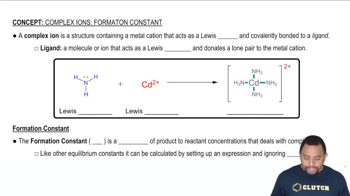
Formation Constants

Formation constants (Kf) quantify the stability of complex ions in solution. A higher formation constant indicates a more stable complex, as it reflects the equilibrium between the free metal ion and the complex. In this context, the formation constants for Ni(en)3^2+ and Ni(NH3)6^2+ suggest that the ethylenediamine complex is significantly more stable than the ammonia complex.
Video consigliato:
Percorso guidato
02:20
Complex Ions and Formation Constant

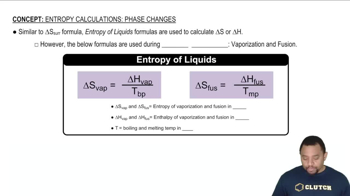
Enthalpy and Entropy Changes

Enthalpy (ΔH) and entropy (ΔS) are thermodynamic properties that describe the heat content and disorder of a system, respectively. In the context of complex formation, ΔH reflects the energy change associated with bond formation, while ΔS indicates the change in disorder when reactants form products. The relationship between these changes is crucial for understanding the stability and spontaneity of the complexation reactions.
Video consigliato:
Percorso guidato
01:46
Entropy in Phase Changes

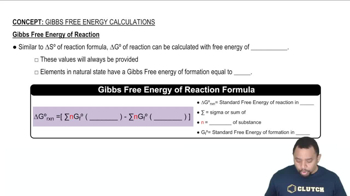
Gibbs Free Energy

Gibbs Free Energy (ΔG) is a thermodynamic potential that determines the spontaneity of a reaction at constant temperature and pressure. It is related to enthalpy and entropy by the equation ΔG = ΔH - TΔS. For the complexes in question, if ΔH°2 - ΔH°1 is zero, the difference in Gibbs Free Energy can be analyzed through the entropy changes, allowing for the calculation of ΔS°2 - ΔS°1 to assess the relative stability of the complexes.
Video consigliato:
Percorso guidato
01:51
Gibbs Free Energy of Reactions
Pratica correlata
Domanda del libro di testo
Consider the gas-phase reaction of AB3 and A2 molecules:

(a) Write a balanced equation for the reaction. (b) What is the sign of the entropy change for the reaction?
797
views

Domanda del libro di testo
Consider the following graph of total free energy of reactants and products versus reaction progress for the general reaction, Reactants -> Products. At which of the four points (labeled a, b, c, and d) is Q < K?

(a) Point a (b) Point c and d (c) Point a, c, and d (d) Point b
388
views
Domanda del libro di testo

Ideal gases A (red spheres) and B (blue spheres) occupy two separate bulbs. The contents of both bulbs constitute the initial state of an isolated system. Consider the process that occurs when the stopcock is opened.

(b) What are the signs ( + , - , or 0) of ∆H, ∆S, and ∆G for this process? Explain.

280
views
Domanda del libro di testo

Ideal gases A (red spheres) and B (blue spheres) occupy two separate bulbs. The contents of both bulbs constitute the initial state of an isolated system. Consider the process that occurs when the stopcock is opened.

(a) Sketch the final (equilibrium) state of the system.

263
views
Domanda del libro di testo
Ammonium hydrogen sulfide, a stink bomb ingredient, decomposes to ammonia and hydrogen sulfide: Calculate the standard free-energy change for the rection at 25 °C if the total pressure resulting from the solid NH4S placed in an evacuated container is 0.658 atm at 25 °C. (a) -43.8 kJ (b) +1.04 kJ (c) -462 kJ (d) +5.51 kJ
464
views
Domanda del libro di testo

Spinach contains a lot of iron but is not a good source of dietary iron because nearly all the iron is tied up in the oxalate complex [Fe(C2O4)3]3-.

(b) Under the acidic conditions in the stomach, the Fe3+ concentration should be greater because of the reaction

[Fe(C2O4)3]3-(aq) + 6 H3O+(aq) ⇌ Fe3+(aq) + 3 H2C2O4(aq) + 6 H2O(l)

Show, however, that this reaction is nonspontaneous under standard-state conditions. (For H2C2O4, Ka1 = 5.9 × 10⁻² and Ka2 = 6.4 × 10⁻⁵.)

99
views