Ch.18 - Thermodynamics: Entropy, Free Energy & Equilibrium
McMurry - Chemistry 8th Edition
McMurry8th EditionChemistryISBN: 9781292336145Non è quello che usi tu?Cambia libro di testo
Capitolo 18, Problema 141b

Consider the unbalanced equation: (b) Use the data in Appendix B and ΔG°f for IO3-(aq)= -128.0 kJ/mol to calculate ΔG° for the reaction at 25 °C.

Guida verificata passo dopo passo
1
insert step 1> Identify the balanced chemical equation for the reaction.
insert step 2> Use the standard Gibbs free energy of formation (ΔG°f) values from Appendix B for each reactant and product in the balanced equation.
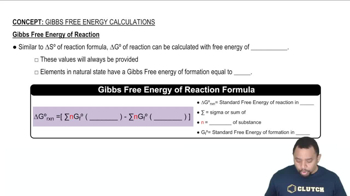
insert step 3> Calculate the ΔG° for the reaction using the formula: ΔG° = Σ(ΔG°f of products) - Σ(ΔG°f of reactants).
insert step 4> Substitute the given ΔG°f value for IO_3^-(aq) and the values from Appendix B into the equation.
insert step 5> Perform the arithmetic to find the ΔG° for the reaction at 25 °C.

Risposta video verificata per un problema simile:

Questa soluzione video è stata consigliata dai nostri tutor come utile per risolvere questo problema.
Durata del video:
2m

Concetti chiave

Ecco i concetti essenziali che devi comprendere per rispondere correttamente alla domanda.

Gibbs Free Energy (ΔG)

Gibbs Free Energy (ΔG) is a thermodynamic potential that measures the maximum reversible work obtainable from a thermodynamic system at constant temperature and pressure. It is a crucial concept in predicting the spontaneity of a reaction; a negative ΔG indicates that a reaction can occur spontaneously, while a positive ΔG suggests non-spontaneity.
Video consigliato:
Percorso guidato
01:51
Gibbs Free Energy of Reactions

Standard Gibbs Free Energy of Formation (ΔG°f)

The Standard Gibbs Free Energy of Formation (ΔG°f) is the change in Gibbs free energy when one mole of a compound is formed from its elements in their standard states. This value is essential for calculating the ΔG of a reaction, as it allows for the determination of the energy changes associated with the formation of reactants and products.
Video consigliato:
Percorso guidato
00:32
Standard Gibbs Free Energy and Temperature

Reaction Quotient and Equilibrium

The reaction quotient (Q) is a measure of the relative concentrations of products and reactants at any point in a reaction. At equilibrium, Q equals the equilibrium constant (K). Understanding how ΔG relates to Q and K is vital for predicting the direction of a reaction and calculating the ΔG under non-standard conditions.
Video consigliato:
Percorso guidato
00:49
Reaction Quotient Q
Pratica correlata
Domanda del libro di testo

Consider the unbalanced equation: I2(s) → I-(aq) + IO3-(aq) (d) What pH is required for the reaction to be at equilibrium at 25°C when [I-] = 0.10M and [IO3-] = 0.50 M?

317
views

Domanda del libro di testo

The lead storage battery uses the reaction: (b) Calculate ∆G for this reaction on a cold winter's day (10 °F) in a battery that has run down to the point where the sulfuric acid concentration is only 0.100 M.

366
views
Domanda del libro di testo

Methanol (CH3OH) is made industrially in two steps from CO and H2. It is so cheap to make that it is being considered for use as a precursor to hydrocarbon fuels, such as methane (CH4):

Step 1. CO(g) + 2 H2(g) S CH3OH(l) ΔS° = - 332 J/K

Step 2. CH3OH1l2 → CH4(g) + 1/2 O2(g) ΔS° = 162 J/K

(k) Calculate an overall ΔG°, ΔH°, and ΔS° for the formation of CH4 from CO and H2.

365
views
Domanda del libro di testo
Chloroform has ΔHvaporization = 29.2 kJ>mol and boils at 61.2 °C. What is the value of ΔSvaporization for chloroform?
770
views
Domanda del libro di testo

Methanol (CH3OH) is made industrially in two steps from CO and H2. It is so cheap to make that it is being considered for use as a precursor to hydrocarbon fuels, such as methane (CH4):

Step 1. CO(g) + 2 H2(g) S CH3OH(l) ΔS° = - 332 J/K

Step 2. CH3OH1l2 → CH4(g) + 1/2 O2(g) ΔS° = 162 J/K

(l) Is the overall reaction spontaneous at 298 K?

278
views
Domanda del libro di testo

Consider the unbalanced equation: (a) Balance the equation for this reaction in basic solution.

378
views