Ch.18 - Thermodynamics: Entropy, Free Energy & Equilibrium
McMurry - Chemistry 8th Edition
McMurry8th EditionChemistryISBN: 9781292336145Non è quello che usi tu?Cambia libro di testo
Capitolo 18, Problema 138b

The lead storage battery uses the reaction: (b) Calculate ∆G for this reaction on a cold winter's day (10 °F) in a battery that has run down to the point where the sulfuric acid concentration is only 0.100 M.

Guida verificata passo dopo passo
1
Convert the temperature from Fahrenheit to Celsius using the formula: \( T(°C) = \frac{5}{9}(T(°F) - 32) \).
Convert the temperature from Celsius to Kelvin by adding 273.15 to the Celsius temperature.
Write the balanced chemical equation for the lead storage battery reaction.
Use the Nernst equation: \( \Delta G = \Delta G^\circ + RT \ln Q \), where \( Q \) is the reaction quotient, \( R \) is the gas constant (8.314 J/mol·K), and \( T \) is the temperature in Kelvin.
Calculate the reaction quotient \( Q \) using the concentrations of the reactants and products, and then substitute \( Q \), \( R \), and \( T \) into the Nernst equation to find \( \Delta G \).

Risposta video verificata per un problema simile:

Questa soluzione video è stata consigliata dai nostri tutor come utile per risolvere questo problema.
Durata del video:
3m

Concetti chiave

Ecco i concetti essenziali che devi comprendere per rispondere correttamente alla domanda.

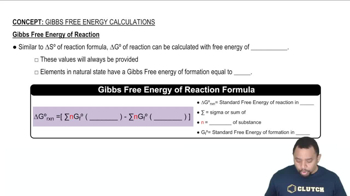
Gibbs Free Energy (∆G)

Gibbs Free Energy (∆G) is a thermodynamic potential that measures the maximum reversible work obtainable from a thermodynamic system at constant temperature and pressure. It is crucial for determining the spontaneity of a reaction; a negative ∆G indicates a spontaneous process, while a positive ∆G suggests non-spontaneity. The relationship between ∆G, enthalpy (∆H), and entropy (∆S) is given by the equation ∆G = ∆H - T∆S.
Video consigliato:
Percorso guidato
01:51
Gibbs Free Energy of Reactions

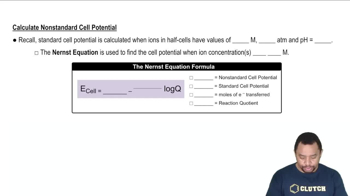
Nernst Equation

The Nernst Equation relates the cell potential of an electrochemical reaction to the concentrations of the reactants and products. It is expressed as E = E° - (RT/nF) ln(Q), where E° is the standard cell potential, R is the gas constant, T is the temperature in Kelvin, n is the number of moles of electrons transferred, F is Faraday's constant, and Q is the reaction quotient. This equation is essential for calculating the cell potential under non-standard conditions, such as varying concentrations.
Video consigliato:
Percorso guidato
01:17
The Nernst Equation

Concentration Effects on Reaction Equilibrium

The concentration of reactants and products affects the position of equilibrium in a chemical reaction, as described by Le Chatelier's Principle. When the concentration of a reactant is decreased, the equilibrium shifts to favor the formation of more reactants, while an increase in product concentration shifts it towards products. In the context of the lead storage battery, the low concentration of sulfuric acid (0.100 M) will influence the Gibbs Free Energy and the overall cell potential, impacting the battery's performance.
Video consigliato:
Percorso guidato
02:31
Photoelectric Effect