
Ch.18 - Thermodynamics: Entropy, Free Energy & Equilibrium
McMurry - Chemistry 8th Edition
McMurry8th EditionChemistryISBN: 9781292336145Non è quello che usi tu?Cambia libro di testo
Capitolo 18, Problema 113

Do you expect a large or small value of the equilibrium constant for a reaction with the following values of ∆G°? (a) ∆G° is positive. (b) ∆G° is negative.

Guida verificata passo dopo passo
1
Step 1: Understand the relationship between the standard Gibbs free energy change (∆G°) and the equilibrium constant (K) using the equation: ∆G° = -RT ln(K), where R is the universal gas constant and T is the temperature in Kelvin.
Step 2: Analyze the case when ∆G° is positive. A positive ∆G° indicates that the reaction is non-spontaneous under standard conditions, which implies that the equilibrium constant K will be less than 1, indicating a small value.
Step 3: Consider the case when ∆G° is negative. A negative ∆G° suggests that the reaction is spontaneous under standard conditions, which means the equilibrium constant K will be greater than 1, indicating a large value.
Step 4: Recall that a large equilibrium constant (K > 1) means the products are favored at equilibrium, while a small equilibrium constant (K < 1) means the reactants are favored.
Step 5: Conclude that the sign of ∆G° directly influences the magnitude of the equilibrium constant, with positive ∆G° leading to a small K and negative ∆G° leading to a large K.

Concetti chiave

Ecco i concetti essenziali che devi comprendere per rispondere correttamente alla domanda.

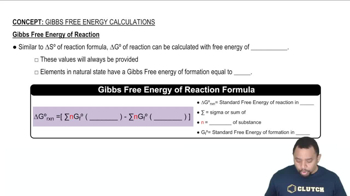
Gibbs Free Energy (∆G°)

Gibbs Free Energy (∆G°) is a thermodynamic potential that measures the maximum reversible work obtainable from a thermodynamic system at constant temperature and pressure. A positive ∆G° indicates that a reaction is non-spontaneous under standard conditions, while a negative ∆G° suggests that the reaction is spontaneous. The sign of ∆G° is crucial for predicting the direction of a chemical reaction.
Video consigliato:
Percorso guidato
01:51
Gibbs Free Energy of Reactions

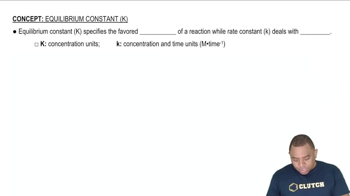
Equilibrium Constant (K)

The equilibrium constant (K) is a dimensionless value that expresses the ratio of the concentrations of products to reactants at equilibrium for a given reaction at a specific temperature. A large K value (K >> 1) indicates that products are favored at equilibrium, while a small K value (K << 1) suggests that reactants are favored. The relationship between K and ∆G° is fundamental in understanding reaction spontaneity.
Video consigliato:
Percorso guidato
01:14
Equilibrium Constant K

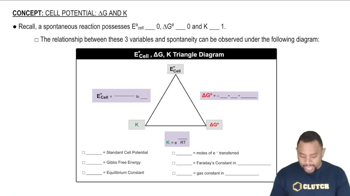
Relationship between ∆G° and K

The relationship between Gibbs Free Energy (∆G°) and the equilibrium constant (K) is given by the equation ∆G° = -RT ln(K), where R is the universal gas constant and T is the temperature in Kelvin. This equation shows that a negative ∆G° corresponds to a large K, indicating that the reaction favors products, while a positive ∆G° corresponds to a small K, indicating that reactants are favored. Understanding this relationship is essential for predicting the behavior of chemical reactions.
Video consigliato:
Percorso guidato
02:43
Relationship between ∆E°, ∆G°, and K
Pratica correlata
Domanda del libro di testo

Consider the Haber synthesis of gaseous NH3 (∆H°f = -46.1 kJ/mol; ∆G°f = -16.5 kJ/mol: (d) What are the equilibrium constants Kp and Kc for the reaction at 350 K? Assume that ∆H° and ∆S° are independent of temperature.

490
views
Domanda del libro di testo
Ammonium nitrate is dangerous because it decomposes (sometimes explosively) when heated: (a) Using the data in Appendix B, show that this reaction is spontaneous at 25 °C.
334
views
Domanda del libro di testo

Use the data in Appendix B to calculate the equilibrium pressure of CO2 in a closed 1 L vessel that contains each of the following samples:

(a) 15 g of MgCO3 and 1.0 g of MgO at 25 °C

(b) 15 g of MgCO3 and 1.0 g of MgO at 280 °C .

Assume that ∆H° and ∆S° are independent of temperature.

308
views
Domanda del libro di testo
Use the data in Appendix B to calculate ∆G for the decom-position of nitrosyl chloride at 25 °C when the partial pressures are 2.00 atm of NOCl, 1.00 * 10^-3 atm of NO, and 1.00 * 10^-3 atm of Cl2: Is the reaction spontaneous in the forward or the reverse direction under these conditions?
328
views
Domanda del libro di testo
Urea (NH2CONH2), an important nitrogen fertilizer, is produced industrially by the reaction Given that ∆G° = -13.6 kJ, calculate ∆G at 25 °C for the following sets of conditions. . (a) 10 atm NH3, 10 atm CO2, 1.0 M NH2CONH2 (b) 0.10 atm NH3, 0.10 atm CO2, 1.0 M NH2CONH2 Is the reaction spontaneous for the conditions in part (a) and/or part (b)?
2195
views