Domanda del libro di testo
Consider the gas-phase reaction of AB3 and A2 molecules:
(a) Write a balanced equation for the reaction.
(b) What is the sign of the entropy change for the reaction?
797
views

 McMurry 8th EditionCh.18 - Thermodynamics: Entropy, Free Energy & EquilibriumProblema 27b
 Guida verificata passo dopo passo
 02:34
02:34
 02:46
02:46 01:51
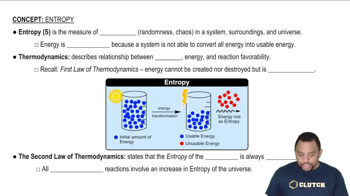
01:51Ideal gases A (red spheres) and B (blue spheres) occupy two separate bulbs. The contents of both bulbs constitute the initial state of an isolated system. Consider the process that occurs when the stopcock is opened.
(a) Sketch the final (equilibrium) state of the system.
Ideal gases A (red spheres) and B (blue spheres) occupy two separate bulbs. The contents of both bulbs constitute the initial state of an isolated system. Consider the process that occurs when the stopcock is opened.
(c) How dpes this process illustrate the second law of thermodynamics?
Formation constants for the ammonia and ethylenediamine complexes of nickel(II) indicate that Ni(en)32+ is much more
stable than Ni(NH3)62+:
(1) <REACTION>
(2) <REACTION>
The enthalpy changes for the two reactions, ΔH°1 and ΔH°2, should be about the same because both complexes have six Ni﹣N bonds.
(c) Assuming that ΔH°2 - ΔH°1 is zero, calculate the value of ΔS°2 - ΔS°1.
Ideal gases A (red spheres) and B (blue spheres) occupy two separate bulbs. The contents of both bulbs constitute the initial state of an isolated system. Consider the process that occurs when the stopcock is opened.
(d) Relate each of the pictures to the graph in Figure 18.11.