Ch.19 - Electrochemistry
McMurry - Chemistry 8th Edition
McMurry8th EditionChemistryISBN: 9781292336145Non è quello che usi tu?Cambia libro di testo
Capitolo 19, Problema 133

(a) Sketch a cell with inert electrodes suitable for the elec-trolysis of an aqueous solution of sulfuric acid. Label the anode and cathode, and indicate the direction of electron and ion flow. Identify the positive and negative electrodes. (b) Write balanced equations for the anode, cathode, and overall cell reactions.

Guida verificata passo dopo passo
1
(a) Begin by sketching a simple electrochemical cell with two inert electrodes, such as platinum or graphite, immersed in an aqueous solution of sulfuric acid (H2SO4).
(a) Label the anode on the left side of the cell and the cathode on the right side. Remember, in electrolysis, the anode is positive and the cathode is negative.
(a) Indicate the direction of electron flow from the anode to the cathode through an external circuit. Also, show the flow of ions in the solution: H+ ions move towards the cathode, and SO4^2- ions move towards the anode.
(b) Write the half-reaction at the anode: 2H2O(l) → O2(g) + 4H+(aq) + 4e^-. This represents the oxidation of water to oxygen gas.
(b) Write the half-reaction at the cathode: 4H+(aq) + 4e^- → 2H2(g). This represents the reduction of protons to hydrogen gas. Combine these to write the overall cell reaction: 2H2O(l) → 2H2(g) + O2(g).

Risposta video verificata per un problema simile:

Questa soluzione video è stata consigliata dai nostri tutor come utile per risolvere questo problema.
Durata del video:
2m

Concetti chiave

Ecco i concetti essenziali che devi comprendere per rispondere correttamente alla domanda.

Electrolysis

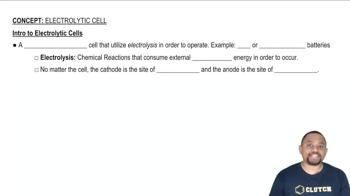
Electrolysis is a chemical process that uses electrical energy to drive a non-spontaneous reaction. In this process, an electric current is passed through an electrolyte, causing the decomposition of the substance. In the case of sulfuric acid, water and sulfate ions are involved, leading to the production of hydrogen and oxygen gases at the electrodes.
Video consigliato:
Percorso guidato
01:21
The Electrolytic Cell

Electrodes and Their Functions

In electrolysis, electrodes are conductive materials that facilitate the flow of electricity into and out of the electrolyte. The anode is the positive electrode where oxidation occurs, while the cathode is the negative electrode where reduction takes place. Understanding the roles of these electrodes is crucial for predicting the products of the electrolysis process.
Video consigliato:
Percorso guidato
03:37
Logarithmic Functions

Half-Reactions and Balancing Equations

Half-reactions represent the individual oxidation and reduction processes occurring at the electrodes during electrolysis. Balancing these half-reactions is essential to ensure that the number of atoms and charge are conserved in the overall reaction. This involves writing separate equations for the anode and cathode reactions and then combining them to form a balanced overall equation.
Video consigliato:
Percorso guidato
01:32
Balancing Chemical Equations