Ch.19 - Electrochemistry
McMurry - Chemistry 8th Edition
McMurry8th EditionChemistryISBN: 9781292336145Non è quello che usi tu?Cambia libro di testo
Capitolo 19, Problema 136b

Predict the anode, cathode, and overall cell reactions when an aqueous solution of each of the following salts is electrolyzed in a cell having inert electrodes. (b) CuCl2

Guida verificata passo dopo passo
1
Identify the ions present in the aqueous solution of CuCl_2. The solution will contain Cu^{2+} and Cl^- ions.
Determine the possible reactions at the anode. In aqueous solutions, the anode reaction can involve the oxidation of Cl^- ions to Cl_2 gas or the oxidation of water to O_2 gas.
Determine the possible reactions at the cathode. The cathode reaction can involve the reduction of Cu^{2+} ions to solid Cu or the reduction of water to H_2 gas.
Compare the standard electrode potentials for the possible reactions at the anode and cathode to determine which reactions are more favorable. The reaction with the more positive potential at the anode and the more negative potential at the cathode will occur.
Write the overall cell reaction by combining the half-reactions from the anode and cathode, ensuring that the electrons are balanced.

Risposta video verificata per un problema simile:

Questa soluzione video è stata consigliata dai nostri tutor come utile per risolvere questo problema.
Durata del video:
3m

Concetti chiave

Ecco i concetti essenziali che devi comprendere per rispondere correttamente alla domanda.

Electrolysis

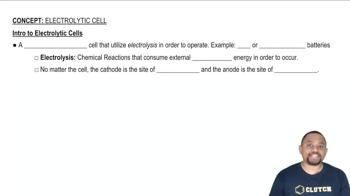
Electrolysis is a chemical process that uses electrical energy to drive a non-spontaneous reaction. In an electrolytic cell, an external voltage is applied to facilitate the movement of ions in an electrolyte solution, leading to the oxidation and reduction reactions at the electrodes. Understanding electrolysis is crucial for predicting the products formed during the electrolysis of compounds like CuCl2.
Video consigliato:
Percorso guidato
01:21
The Electrolytic Cell

Anode and Cathode Reactions

In electrolysis, the anode is the electrode where oxidation occurs, while the cathode is where reduction takes place. For CuCl2, at the anode, chloride ions (Cl-) are oxidized to chlorine gas (Cl2), and at the cathode, copper ions (Cu2+) are reduced to solid copper (Cu). Identifying these reactions is essential for predicting the overall cell reaction.
Video consigliato:
Percorso guidato
01:30
Alcohol Reactions: Dehydration Reactions

Inert Electrodes

Inert electrodes, such as platinum or graphite, do not participate in the chemical reactions occurring during electrolysis. Their primary role is to provide a surface for the oxidation and reduction reactions without interfering with the electrolyte's chemistry. Understanding the function of inert electrodes helps clarify how the electrolysis process proceeds without altering the composition of the electrodes themselves.
Video consigliato:
Percorso guidato
04:44
Electron Geometry