
Ch.19 - Electrochemistry
McMurry - Chemistry 8th Edition
McMurry8th EditionChemistryISBN: 9781292336145Non è quello che usi tu?Cambia libro di testo
Capitolo 19, Problema 121b

A storm has knocked out power to your beach house, and you would like to build a battery from household items to charge your iPhone. You have the following materials. alum in the kitchen, which can be used to make a 1.0 M Al3+ solution bleach, which is a solution that is approximately a 1.0 M in ClO-aluminum foil, a platinum necklace and bologna, which can be used as a salt bridge (b) What voltage can be generated?

Guida verificata passo dopo passo
1
Identify the half-reactions for the redox process. The aluminum foil can act as the anode, where Al is oxidized to Al^{3+}, and the ClO^- from bleach can act as the cathode, where it is reduced.
Write the oxidation half-reaction: Al \(\rightarrow\) Al^{3+} + 3e^-.
Write the reduction half-reaction: ClO^- + 2H_2O + 2e^- \(\rightarrow\) Cl^- + 2OH^-.
Use the standard reduction potentials to find the cell potential. Look up the standard reduction potential for each half-reaction: E^\(\circ\)_{Al^{3+}/Al} and E^\(\circ\)_{ClO^-/Cl^-}.
Calculate the standard cell potential (E^\(\circ\)_{cell}) using the formula: E^\(\circ\)_{cell} = E^\(\circ\)_{cathode} - E^\(\circ\)_{anode}.

Risposta video verificata per un problema simile:

Questa soluzione video è stata consigliata dai nostri tutor come utile per risolvere questo problema.
Durata del video:
4m

Concetti chiave

Ecco i concetti essenziali che devi comprendere per rispondere correttamente alla domanda.

Electrochemistry

Electrochemistry is the branch of chemistry that deals with the relationship between electrical energy and chemical reactions. It involves the study of redox reactions, where oxidation and reduction occur, leading to the generation of electrical energy. Understanding electrochemical cells, including galvanic cells, is essential for determining how to create a battery from available materials.
Video consigliato:
Percorso guidato
01:40
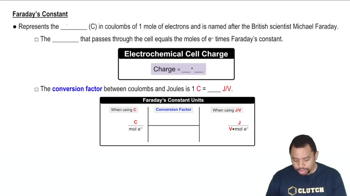
Faraday's Constant in Electrochemistry

Electrode Potential

Electrode potential refers to the voltage developed at an electrode due to the chemical reaction occurring at its surface. Each half-reaction in an electrochemical cell has a standard electrode potential, which can be used to calculate the overall cell potential. The difference in electrode potentials between the anode and cathode determines the voltage output of the battery.
Video consigliato:
Percorso guidato
01:27
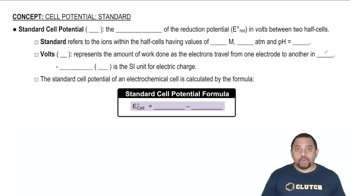
Standard Cell Potential

Salt Bridge

A salt bridge is a device used in electrochemical cells to maintain electrical neutrality by allowing the flow of ions between the two half-cells. It typically contains a gel or solution of an inert electrolyte, which helps to balance the charge as the redox reactions proceed. In this scenario, using bologna as a salt bridge can facilitate ion movement, crucial for the battery's operation.
Video consigliato:
Pratica correlata
Domanda del libro di testo

You are on your dream vacation at the beach when a major storm knocks out the power for days. Your cell phone is dead, and you want to make a battery to charge it. You find the following materials in the beach house. blue stone algaecide for pools, which can be used to make a 1.0 M Cu2+ solution alum in the kitchen, which can be used to make a 1.0 M Al3+ solution aluminum foil, copper wire, and bologna, which can be used as a salt bridge. (d) An iPhone requires 5.0 V for charging. Can this battery charge the phone? Explain.

310
views
Domanda del libro di testo

A storm has knocked out power to your beach house, and you would like to build a battery from household items to charge your iPhone. You have the following materials. alum in the kitchen, which can be used to make a 1.0 M Al3+ solution bleach, which is a solution that is approximately a 1.0 M in ClO-aluminum foil, a platinum necklace and bologna, which can be used as a salt bridge (a) What are the half-reactions and overall reaction in the battery?

203
views
Domanda del libro di testo

You are on your dream vacation at the beach when a major storm knocks out the power for days. Your cell phone is dead, and you want to make a battery to charge it. You find the following materials in the beach house. blue stone algaecide for pools, which can be used to make a 1.0 M Cu2+ solution alum in the kitchen, which can be used to make a 1.0 M Al3+ solution aluminum foil, copper wire, and bologna, which can be used as a salt bridge. (b) What voltage can be generated?

363
views
Domanda del libro di testo

A mercury battery uses the following electrode half-reactions: (b) Calculate ∆G° (in kilojoules) and K at 25 °C for the cell reaction.

747
views
Domanda del libro di testo

A storm has knocked out power to your beach house, and you would like to build a battery from household items to charge your iPhone. You have the following materials. alum in the kitchen, which can be used to make a 1.0 M Al3+ solution bleach, which is a solution that is approximately a 1.0 M in ClO-aluminum foil, a platinum necklace and bologna, which can be used as a salt bridge (d) An iPhone requires 5.0 V for charging. Can this battery charge the phone? Explain.

1
views