Ch.19 - Electrochemistry
McMurry - Chemistry 8th Edition
McMurry8th EditionChemistryISBN: 9781292336145Non è quello che usi tu?Cambia libro di testo
Capitolo 19, Problema 123b

A mercury battery uses the following electrode half-reactions: (b) Calculate ∆G° (in kilojoules) and K at 25 °C for the cell reaction.

Guida verificata passo dopo passo
1
Identify the half-reactions involved in the mercury battery. Typically, these might be the reduction of mercury(II) oxide and the oxidation of zinc.
Write the balanced overall cell reaction by combining the two half-reactions. Ensure that the number of electrons lost in the oxidation half-reaction equals the number of electrons gained in the reduction half-reaction.
Calculate the standard cell potential, E°_cell, by using the standard reduction potentials for each half-reaction: E°_cell = E°_cathode - E°_anode.
Use the Nernst equation to relate the standard cell potential to the standard Gibbs free energy change: ∆G° = -nFE°_cell, where n is the number of moles of electrons transferred and F is the Faraday constant (approximately 96485 C/mol).
Calculate the equilibrium constant, K, using the relationship between ∆G° and K: ∆G° = -RTlnK, where R is the universal gas constant (8.314 J/mol·K) and T is the temperature in Kelvin (298 K for 25 °C).

Risposta video verificata per un problema simile:

Questa soluzione video è stata consigliata dai nostri tutor come utile per risolvere questo problema.
Durata del video:
2m

Concetti chiave

Ecco i concetti essenziali che devi comprendere per rispondere correttamente alla domanda.

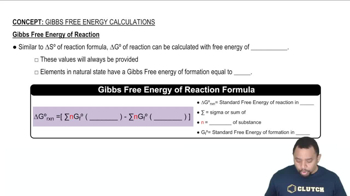
Gibbs Free Energy (∆G°)

Gibbs Free Energy (∆G°) is a thermodynamic potential that measures the maximum reversible work obtainable from a thermodynamic system at constant temperature and pressure. It is crucial for determining the spontaneity of a reaction; a negative ∆G° indicates a spontaneous process, while a positive value suggests non-spontaneity. The relationship between Gibbs Free Energy and the equilibrium constant (K) is given by the equation ∆G° = -RT ln(K), where R is the universal gas constant and T is the temperature in Kelvin.
Video consigliato:
Percorso guidato
01:51
Gibbs Free Energy of Reactions

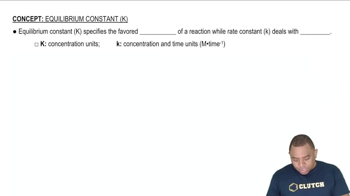
Equilibrium Constant (K)

The equilibrium constant (K) quantifies the ratio of the concentrations of products to reactants at equilibrium for a given reaction at a specific temperature. It provides insight into the extent of a reaction; a large K value indicates that products are favored, while a small K suggests reactants are favored. The relationship between K and Gibbs Free Energy allows for the calculation of K from ∆G° and vice versa, making it essential for analyzing electrochemical cells.
Video consigliato:
Percorso guidato
01:14
Equilibrium Constant K

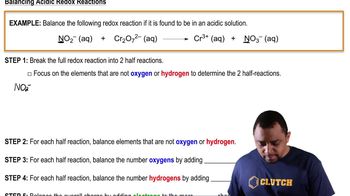
Electrode Half-Reactions

Electrode half-reactions represent the individual oxidation or reduction processes occurring at the electrodes of an electrochemical cell. Each half-reaction can be expressed in terms of the transfer of electrons, which is fundamental for calculating the overall cell reaction and its thermodynamic properties. Understanding these half-reactions is essential for determining the cell potential and subsequently calculating Gibbs Free Energy and the equilibrium constant for the entire cell reaction.
Video consigliato:
Percorso guidato
07:19
Redox Half Reactions Example
Pratica correlata
Domanda del libro di testo

A mercury battery uses the following electrode half-reactions: (c) What is the effect on the cell voltage of a tenfold change in the concentration of KOH in the electrolyte? Explain..

454
views

Domanda del libro di testo

A storm has knocked out power to your beach house, and you would like to build a battery from household items to charge your iPhone. You have the following materials. alum in the kitchen, which can be used to make a 1.0 M Al3+ solution bleach, which is a solution that is approximately a 1.0 M in ClO-aluminum foil, a platinum necklace and bologna, which can be used as a salt bridge (b) What voltage can be generated?

290
views
Domanda del libro di testo
Which of the following describes the process of galvanization that protects steel from rusting? (a) Steel is coated with a layer of paint. (b) Iron in steel is oxidized to form a protective oxide coating. (c) Steel is coated with zinc because zinc is more easily oxidized than iron. (d) A strip of magnesium is attached to steel because the magnesium is more easily oxidized than iron.
711
views
Domanda del libro di testo
How does the pH of the solution affect the formation of rust?
573
views
Domanda del libro di testo

A storm has knocked out power to your beach house, and you would like to build a battery from household items to charge your iPhone. You have the following materials. alum in the kitchen, which can be used to make a 1.0 M Al3+ solution bleach, which is a solution that is approximately a 1.0 M in ClO-aluminum foil, a platinum necklace and bologna, which can be used as a salt bridge (d) An iPhone requires 5.0 V for charging. Can this battery charge the phone? Explain.

1
views