Ch.19 - Electrochemistry
McMurry - Chemistry 8th Edition
McMurry8th EditionChemistryISBN: 9781292336145Non è quello che usi tu?Cambia libro di testo
Capitolo 19, Problema 103

At one time on Earth, iron was present mostly as iron(II). Later, once plants had produced a significant quantity of oxygen in the atmosphere, the iron became oxidized to iron(III). Show that Fe2+(aq) can be spontaneously oxidized to Fe3+(aq) by O2(g) at 25°C assuming the following reasonable environmental conditions:

Guida verificata passo dopo passo
1
Identify the half-reactions involved in the oxidation of Fe^{2+} to Fe^{3+} and the reduction of O_2 to H_2O.
Write the oxidation half-reaction: Fe^{2+} \(\rightarrow\) Fe^{3+} + e^{-}.
Write the reduction half-reaction: O_2 + 4H^+ + 4e^{-} \(\rightarrow\) 2H_2O.
Determine the standard reduction potentials (E^\(\circ\)) for both half-reactions from a standard reduction potential table.
Calculate the standard cell potential (E^\(\circ\)_{cell}) using the formula: E^\(\circ\)_{cell} = E^\(\circ\)_{cathode} - E^\(\circ\)_{anode}. If E^\(\circ\)_{cell} is positive, the reaction is spontaneous.

Risposta video verificata per un problema simile:

Questa soluzione video è stata consigliata dai nostri tutor come utile per risolvere questo problema.
Durata del video:
56s

Concetti chiave

Ecco i concetti essenziali che devi comprendere per rispondere correttamente alla domanda.

Oxidation and Reduction

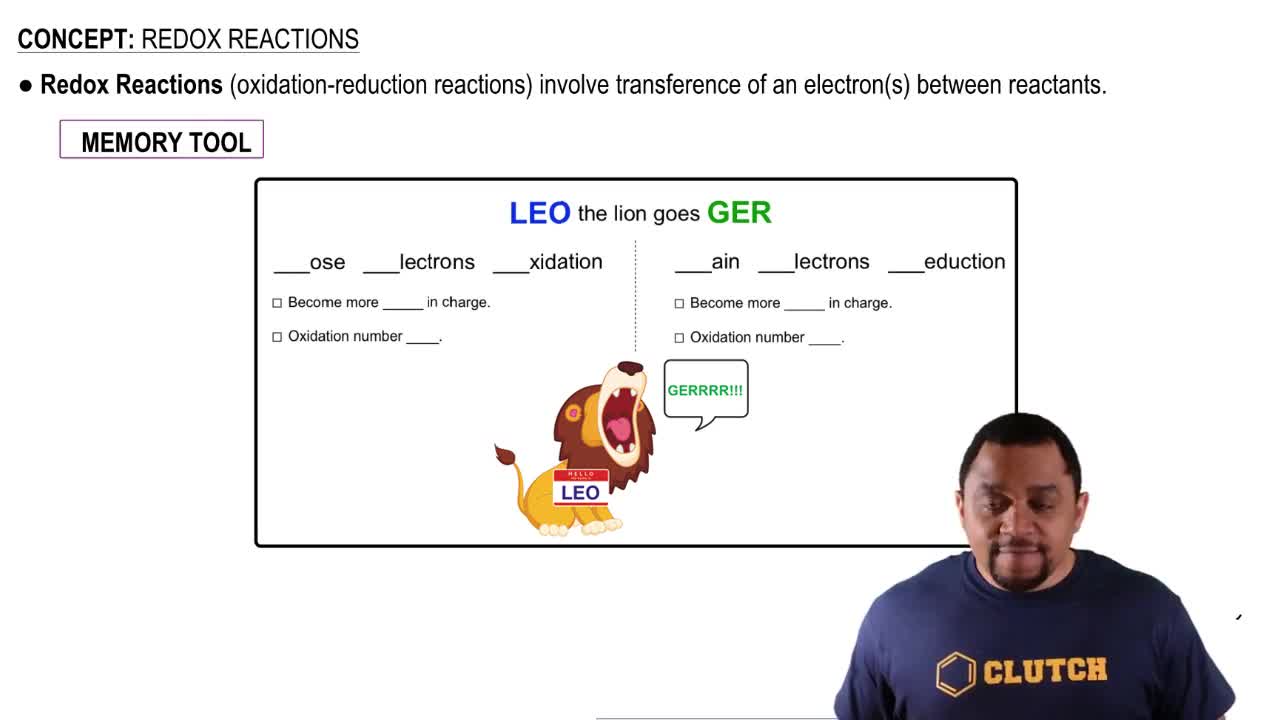
Oxidation refers to the loss of electrons from a substance, while reduction is the gain of electrons. In the context of the question, Fe2+ is oxidized to Fe3+ as it loses an electron, and O2 acts as the oxidizing agent, facilitating this process. Understanding these concepts is crucial for analyzing redox reactions.
Video consigliato:
Percorso guidato
01:53
Oxidation and Reduction Reactions

Standard Electrode Potentials

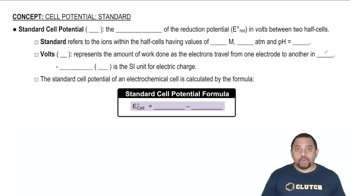
Standard electrode potentials (E°) provide a measure of the tendency of a chemical species to be reduced. The difference in E° values between the half-reactions of Fe2+/Fe3+ and O2/H2O can be used to determine the spontaneity of the reaction. A positive cell potential indicates that the reaction can occur spontaneously under standard conditions.
Video consigliato:
Percorso guidato
01:27
Standard Cell Potential

Gibbs Free Energy

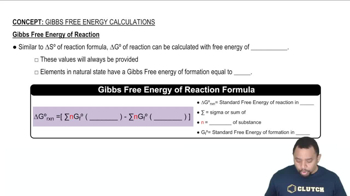
Gibbs free energy (ΔG) is a thermodynamic potential that helps predict the spontaneity of a reaction. A negative ΔG indicates that a reaction can occur spontaneously. The relationship between ΔG, the standard electrode potential, and temperature is essential for determining whether the oxidation of Fe2+ by O2 is thermodynamically favorable.
Video consigliato:
Percorso guidato
01:51
Gibbs Free Energy of Reactions
Pratica correlata
Domanda del libro di testo
What is the pH of the solution in the cathode compartment of the following cell if the measured cell potential at 25 °C is 0.17 V?
837
views

Domanda del libro di testo
Copper reduces dilute nitric acid to nitric oxide (NO) but reduces concentrated nitric acid to nitrogen dioxide (NO2): Assuming that [Cu2+] = 0.10 M and that the partial pressures of NO and NO2 are 1.0 * 10-3 atm, calculate the potential (E) for reactions (1) and (2) at 25 °C and show which reaction has the greater thermodynamic tendency to occur when the concentration of HNO3 is (a) 1.0 M
863
views
Domanda del libro di testo

When suspected drunk drivers are tested with a Breathalyzer, the alcohol (ethanol) in the exhaled breath is oxidized to acetic acid with an acidic solution of potassium dichromate: The color of the solution changes because some of the orange Cr2O72- is converted to the green Cr3+ The Breathalyzer measures the color change and produces a meter reading calibrated in blood alcohol content. (a) What is E° for the reaction if the standard half-cell potential for the reduction of acetic acid to ethanol is 0.058 V?

801
views
Domanda del libro di testo

When suspected drunk drivers are tested with a Breathalyzer, the alcohol (ethanol) in the exhaled breath is oxidized to acetic acid with an acidic solution of potassium dichromate: The color of the solution changes because some of the orange Cr2O72- is converted to the green Cr3+ The Breathalyzer measures the color change and produces a meter reading calibrated in blood alcohol content. (b) What is the value of E for the reaction when the concentrations of ethanol, acetic acid, Cr2O7 are 1.0 M and the pH is 4.00?

975
views