
Ch.19 - Electrochemistry
McMurry - Chemistry 8th Edition
McMurry8th EditionChemistryISBN: 9781292336145Non è quello che usi tu?Cambia libro di testo
Capitolo 19, Problema 102

What is the reduction potential at 25 °C for the hydrogen electrode in each of the following solutions? The half-reaction is . (c) Pure water.

Guida verificata passo dopo passo
1
Identify the half-reaction for the hydrogen electrode, which is typically represented as: \( \text{H}_2(g) + 2\text{e}^- \rightarrow 2\text{H}^+(aq) \).
Understand that the standard reduction potential for the hydrogen electrode is defined as 0 V under standard conditions, which include 1 M concentration of \( \text{H}^+ \) ions.
Recognize that in pure water, the concentration of \( \text{H}^+ \) ions is determined by the autoionization of water, where \( [\text{H}^+] = 10^{-7} \text{M} \) at 25 °C.
Apply the Nernst equation to calculate the reduction potential under non-standard conditions: \( E = E^0 - \frac{RT}{nF} \ln Q \), where \( E^0 \) is the standard reduction potential, \( R \) is the gas constant, \( T \) is the temperature in Kelvin, \( n \) is the number of moles of electrons transferred, \( F \) is Faraday's constant, and \( Q \) is the reaction quotient.
Substitute the known values into the Nernst equation: \( E = 0 - \frac{8.314 \times 298}{2 \times 96485} \ln \left( \frac{1}{[\text{H}^+]^2} \right) \), where \( [\text{H}^+] = 10^{-7} \text{M} \).

Concetti chiave

Ecco i concetti essenziali che devi comprendere per rispondere correttamente alla domanda.

Reduction Potential

Reduction potential is a measure of the tendency of a chemical species to acquire electrons and thereby be reduced. It is expressed in volts and is determined under standard conditions, typically at 25 °C and 1 M concentration. A higher reduction potential indicates a greater likelihood of reduction occurring, making it a crucial concept in electrochemistry.
Video consigliato:
Percorso guidato
01:10
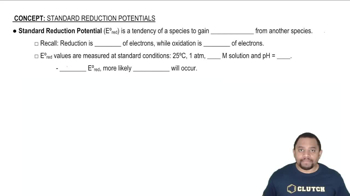
Standard Reduction Potentials

Standard Hydrogen Electrode (SHE)

The Standard Hydrogen Electrode (SHE) is a reference electrode used to measure the reduction potentials of other half-reactions. It is defined as having a potential of 0.00 V at all temperatures and is based on the half-reaction of hydrogen ions gaining electrons to form hydrogen gas. The SHE serves as a baseline for comparing the reactivity of other electrodes.
Video consigliato:
Percorso guidato
02:25
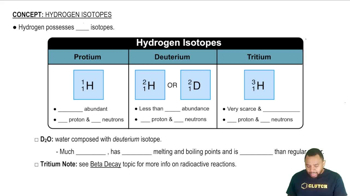
Hydrogen Isotopes

pH and its Effect on Reduction Potential

The pH of a solution significantly influences the reduction potential of the hydrogen electrode. In pure water, the pH is approximately 7, which affects the concentration of hydrogen ions (H+) in the solution. Since the reduction potential is dependent on the concentration of H+, changes in pH can shift the potential, making it essential to consider when calculating the reduction potential in different solutions.
Video consigliato:
Percorso guidato
01:10
Standard Reduction Potentials
Pratica correlata
Domanda del libro di testo
Copper reduces dilute nitric acid to nitric oxide (NO) but reduces concentrated nitric acid to nitrogen dioxide (NO2): Assuming that [Cu2+] = 0.10 M and that the partial pressures of NO and NO2 are 1.0 * 10-3 atm, calculate the potential (E) for reactions (1) and (2) at 25 °C and show which reaction has the greater thermodynamic tendency to occur when the concentration of HNO3 is (a) 1.0 M
863
views
Domanda del libro di testo
The Nernst equation applies to both cell reactions and half-reactions. For the conditions specified, calculate the potential for the following half-reactions at 25 °C. (b)
1298
views
1
rank
Domanda del libro di testo

When suspected drunk drivers are tested with a Breathalyzer, the alcohol (ethanol) in the exhaled breath is oxidized to acetic acid with an acidic solution of potassium dichromate: The color of the solution changes because some of the orange Cr2O72- is converted to the green Cr3+ The Breathalyzer measures the color change and produces a meter reading calibrated in blood alcohol content. (a) What is E° for the reaction if the standard half-cell potential for the reduction of acetic acid to ethanol is 0.058 V?

801
views
Domanda del libro di testo
At one time on Earth, iron was present mostly as iron(II). Later, once plants had produced a significant quantity of oxygen in the atmosphere, the iron became oxidized to iron(III). Show that Fe2+(aq) can be spontaneously oxidized to Fe3+(aq) by O2(g) at 25°C assuming the following reasonable environmental conditions:
761
views
Domanda del libro di testo

When suspected drunk drivers are tested with a Breathalyzer, the alcohol (ethanol) in the exhaled breath is oxidized to acetic acid with an acidic solution of potassium dichromate: The color of the solution changes because some of the orange Cr2O72- is converted to the green Cr3+ The Breathalyzer measures the color change and produces a meter reading calibrated in blood alcohol content. (b) What is the value of E for the reaction when the concentrations of ethanol, acetic acid, Cr2O7 are 1.0 M and the pH is 4.00?

975
views