
Ch.19 - Electrochemistry
McMurry - Chemistry 8th Edition
McMurry8th EditionChemistryISBN: 9781292336145Non è quello che usi tu?Cambia libro di testo
Capitolo 19, Problema 156

Calculate the standard reduction potential for Ba2+ (aq) + 2 e- -> Ba(s) given that ∆G° = 16.7 kJ for the reaction Ba2+(aq) + 2Cl-(aq) -> BaCl2(s). Use any necessary data from Appendices B and D.

Guida verificata passo dopo passo
1
Step 1: Understand the relationship between Gibbs free energy change (\( \Delta G^\circ \)) and the standard cell potential (\( E^\circ \)). The equation that relates these two is \( \Delta G^\circ = -nFE^\circ \), where \( n \) is the number of moles of electrons transferred, and \( F \) is the Faraday constant (approximately 96485 C/mol).
Step 2: Identify the number of electrons transferred in the reduction half-reaction. For the reaction \( \text{Ba}^{2+} (aq) + 2e^- \rightarrow \text{Ba}(s) \), \( n = 2 \) electrons are transferred.
Step 3: Rearrange the equation \( \Delta G^\circ = -nFE^\circ \) to solve for \( E^\circ \). This gives \( E^\circ = -\frac{\Delta G^\circ}{nF} \).
Step 4: Substitute the given \( \Delta G^\circ = 16.7 \text{ kJ} \) into the equation. Remember to convert \( \Delta G^\circ \) from kJ to J by multiplying by 1000, so \( \Delta G^\circ = 16700 \text{ J} \).
Step 5: Calculate \( E^\circ \) using the values: \( n = 2 \), \( F = 96485 \text{ C/mol} \), and \( \Delta G^\circ = 16700 \text{ J} \). Substitute these into the equation \( E^\circ = -\frac{16700}{2 \times 96485} \) to find the standard reduction potential.

Concetti chiave

Ecco i concetti essenziali che devi comprendere per rispondere correttamente alla domanda.

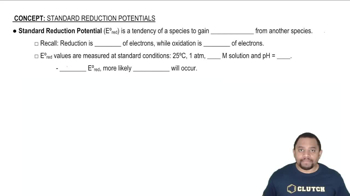
Standard Reduction Potential

Standard reduction potential (E°) is a measure of the tendency of a chemical species to acquire electrons and be reduced. It is measured in volts and is determined under standard conditions (1 M concentration, 1 atm pressure, and 25°C). A higher E° value indicates a greater likelihood of reduction occurring, which is crucial for understanding electrochemical reactions.
Video consigliato:
Percorso guidato
01:10
Standard Reduction Potentials

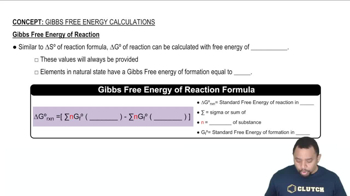
Gibbs Free Energy and its Relation to E°

Gibbs free energy (∆G) is a thermodynamic potential that indicates the spontaneity of a reaction. The relationship between Gibbs free energy and standard reduction potential is given by the equation ∆G° = -nFE°, where n is the number of moles of electrons transferred, F is Faraday's constant, and E° is the standard reduction potential. This relationship allows us to calculate E° from known values of ∆G°.
Video consigliato:
Percorso guidato
01:51
Gibbs Free Energy of Reactions

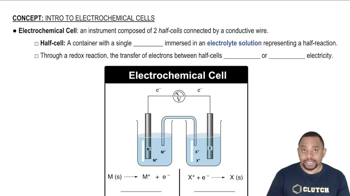
Electrochemical Cell Reactions

Electrochemical cells consist of oxidation and reduction half-reactions. In the given reaction, Ba2+ is reduced to Ba(s), while the overall process involves the formation of BaCl2 from Ba2+ and Cl-. Understanding how to balance these half-reactions and relate them to standard potentials is essential for calculating the overall cell potential and determining the feasibility of the reaction.
Video consigliato:
Percorso guidato
02:46
Electrochemical Cells
Pratica correlata
Domanda del libro di testo

The reaction of MnO4– with oxalic acid (H2C2O4) in acidic solution, yielding Mn2+ and CO2 gas, is widely used to determine the concentration of permanganate solutions. (b) Use the data in Appendix D to calculate E° for the reaction. (c) Show that the reaction goes to completion by calculating the values of ∆G° and K at 25 °C. (H2C2O4) in acidic solution, yielding Mn2+ and CO2 gas, is widely used to determine the concentration of permanganate solutions.

1
views
Domanda del libro di testo

Consider the redox titration (Section 4.13) of 120.0 mL of 0.100 M FeSO4 with 0.120 M K2Cr2O7 at 25 °C, assuming that the pH of the solution is maintained at 2.00 with a suitable buffer. The solution is in contact with a platinum electrode and constitutes one half-cell of an electrochemical cell. The other half-cell is a standard hydrogen electrode. The two half-cells are connected with a wire and a salt bridge, and the progress of the titration is monitored by measuring the cell potential with a voltmeter. (a) Write a balanced net ionic equation for the titration reaction, assuming that the products are Fe3+ and Cr3+.

370
views
Domanda del libro di testo

The reaction of MnO4– with oxalic acid (H2C2O4) in acidic solution, yielding Mn2+ and CO2 gas, is widely used to determine the concentration of permanganate solutions. (a) Write a balanced net ionic equation for the reaction.

853
views
Domanda del libro di testo
Consider a galvanic cell that utilizes the following half-reactions:

(b) What are the values of E° and the equilibrium constant K for the cell reaction at 25 °C?
651
views
Domanda del libro di testo

The reaction of MnO4– with oxalic acid (H2C2O4) in acidic solution, yielding Mn2+ and CO2 gas, is widely used to determine the concentration of permanganate solutions. (d) A 1.200 g sample of sodium oxalate (Na2C2O4) is dissolved in dilute H2SO4 and then titrated with a KMnO4 solution. If 32.50 mL of the KMnO4 solution is required to reach the equivalence point, what is the molarity of the KMnO4 solution?

1607
views
Domanda del libro di testo
A concentration cell has the same half-reactions at the anode and cathode, but a voltage results from different concentrations in the two electrode compartments. (b) A similar cell has 0.10 M Cu2+ in both compartments. When a stoichiometric amount of ethylenediamine (NH2CH2CH2NH2) is added to one compartment, the measured cell potential is 0.179 V. Calculate the formation constant Kf for the complex ion Cu(NH2CH2CH2CH2)22+. Assume there is no volume change.
796
views