Ch.19 - Electrochemistry
McMurry - Chemistry 8th Edition
McMurry8th EditionChemistryISBN: 9781292336145Non è quello che usi tu?Cambia libro di testo
Capitolo 19, Problema 146b

In order to charge a lead storage battery (Section 19.10) 500.0 g of PbSO4(s) must be converted into PbO2(s) and Pb(s). (b) How many coulombs of electrical charge are needed?

Guida verificata passo dopo passo
1
Identify the balanced chemical reaction for the conversion of PbSO_4(s) to PbO_2(s) and Pb(s).
Determine the molar mass of PbSO_4 to convert the given mass (500.0 g) into moles.
Use stoichiometry to find the moles of electrons required for the conversion based on the balanced equation.
Calculate the total charge in coulombs using the relationship between moles of electrons and charge (1 mole of electrons = 96485 C).
Summarize the steps to ensure all conversions and calculations align with the stoichiometry of the reaction.

Risposta video verificata per un problema simile:

Questa soluzione video è stata consigliata dai nostri tutor come utile per risolvere questo problema.
Durata del video:
4m

Concetti chiave

Ecco i concetti essenziali che devi comprendere per rispondere correttamente alla domanda.

Electrochemical Reactions

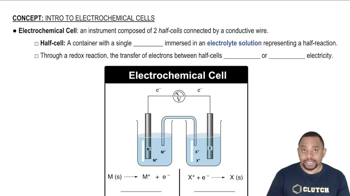
Electrochemical reactions involve the transfer of electrons between chemical species, which is fundamental in processes like charging a battery. In a lead storage battery, lead sulfate (PbSO4) is converted into lead dioxide (PbO2) and lead (Pb) through oxidation and reduction reactions, releasing or consuming electrons in the process.
Video consigliato:
Percorso guidato
02:46
Electrochemical Cells

Faraday's Laws of Electrolysis

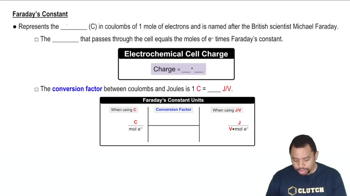
Faraday's Laws of Electrolysis quantify the relationship between the amount of substance transformed at an electrode and the quantity of electric charge passed through the electrolyte. The first law states that the mass of a substance altered at an electrode is directly proportional to the total electric charge passed, which is crucial for calculating the charge needed to convert PbSO4 to PbO2 and Pb.
Video consigliato:
Percorso guidato
01:40
Faraday's Constant in Electrochemistry

Coulombs and Charge Calculation

Coulombs (C) are the standard unit of electric charge in the International System of Units (SI). To determine the total charge required for the conversion of PbSO4 to PbO2 and Pb, one must calculate the moles of electrons involved in the reaction and then use Faraday's constant (approximately 96485 C/mol) to convert moles of electrons to coulombs.
Video consigliato:
Percorso guidato
01:15
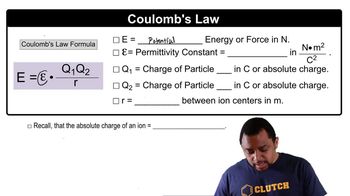
Coulomb's Law Concept 2
Pratica correlata
Domanda del libro di testo
Consider the following half-reactions and E° values: (c) Write the cell reaction for part (b), and calculate the values of E°, ∆G° (in kilojoules), and K for this reaction at 25 °C
723
views

Domanda del libro di testo

When the nickel–zinc battery, used in digital cameras, is recharged, the following cell reaction occurs: (a) How many grams of zinc are formed when 3.35 x 10⁻² g of Ni(OH)2 are consumed?

282
views
Domanda del libro di testo

In order to charge a lead storage battery (Section 19.10) 500.0 g of PbSO4(s) must be converted into PbO2(s) and Pb(s). (a) Does the reaction represent an electrolytic or galvanic cell?

507
views
Domanda del libro di testo

In order to charge a lead storage battery (Section 19.10) 500.0 g of PbSO4(s) must be converted into PbO2(s) and Pb(s). (c) If a current of 500 A is used, how long will it take?

Domanda del libro di testo
Electrolysis of a metal nitrate solution M(NO3)2(aq) for 325 min with a constant current of 20.0 A gives 111 g of the metal. Identify the metal ion M2+.
837
views
Domanda del libro di testo
Aluminum, titanium, and several other metals can be col-ored by an electrochemical process called anodizing. Anodizing oxidizes a metal anode to yield a porous metal oxide coating that can incorporate dye molecules to give brilliant colors. In the oxidation of aluminum, for instance, the electrode reactions are The thickness of the aluminum oxide coating that forms on the anode can be controlled by varying the current flow during the electrolysis. How many minutes are required to produce a 0.0100-mm thick coating of Al2O3 (density 3.97 g/cm^3) on a square piece of aluminum metal 10.0 cm on an edge if the current passed through the piece is 0.600 A?
768
views