When the nickel–zinc battery, used in digital cameras, is recharged, the following cell reaction occurs: (a) How many grams of zinc are formed when 3.35 x 10⁻² g of Ni(OH)2 are consumed?
Ch.19 - Electrochemistry
Capitolo 19, Problema 148
Consider the following half-reactions and E° values: (c) Write the cell reaction for part (b), and calculate the values of E°, ∆G° (in kilojoules), and K for this reaction at 25 °C
Guida verificata passo dopo passo1
Identify the two half-reactions involved in the electrochemical cell and their respective standard reduction potentials (E°).
Write the balanced overall cell reaction by combining the two half-reactions, ensuring that the number of electrons lost in the oxidation half-reaction equals the number of electrons gained in the reduction half-reaction.
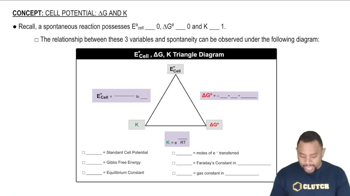
Calculate the standard cell potential (E°_cell) by subtracting the standard reduction potential of the anode (oxidation) from the standard reduction potential of the cathode (reduction): E°_cell = E°_cathode - E°_anode.
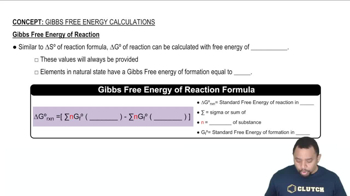
Use the Nernst equation to calculate the standard Gibbs free energy change (∆G°) for the reaction: ∆G° = -nFE°_cell, where n is the number of moles of electrons transferred and F is the Faraday constant (approximately 96485 C/mol).
Calculate the equilibrium constant (K) for the reaction at 25 °C using the relationship between ∆G° and K: ∆G° = -RTlnK, where R is the universal gas constant (8.314 J/mol·K) and T is the temperature in Kelvin (298 K).

Risposta video verificata per un problema simile:
Questa soluzione video è stata consigliata dai nostri tutor come utile per risolvere questo problema.
Durata del video:
4mConcetti chiave
Ecco i concetti essenziali che devi comprendere per rispondere correttamente alla domanda.
Electrode Potential (E°)
Electrode potential, denoted as E°, is a measure of the tendency of a chemical species to be reduced, expressed in volts. It is determined under standard conditions (1 M concentration, 1 atm pressure, and 25 °C). The more positive the E° value, the greater the species' ability to gain electrons and undergo reduction, which is crucial for predicting the direction of electron flow in electrochemical cells.
Video consigliato:
Percorso guidato
Relationship between ∆E°, ∆G°, and K
Gibbs Free Energy (∆G°)
Gibbs free energy change (∆G°) is a thermodynamic quantity that indicates the spontaneity of a reaction at standard conditions. It is calculated using the equation ∆G° = -nFE°, where n is the number of moles of electrons transferred, F is Faraday's constant, and E° is the cell potential. A negative ∆G° indicates a spontaneous reaction, while a positive value suggests non-spontaneity.
Video consigliato:
Percorso guidato
Gibbs Free Energy of Reactions
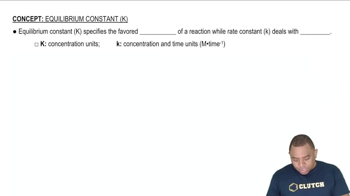
Equilibrium Constant (K)
The equilibrium constant (K) quantifies the ratio of the concentrations of products to reactants at equilibrium for a given reaction. It is related to the Gibbs free energy change by the equation ∆G° = -RT ln(K), where R is the universal gas constant and T is the temperature in Kelvin. A larger K value indicates a reaction that favors product formation, while a smaller K suggests reactants are favored.
Video consigliato:
Percorso guidato
Equilibrium Constant K
Pratica correlata
Domanda del libro di testo
282
views
Domanda del libro di testo
Chlorine can be prepared in the laboratory by the reaction of hydrochloric acid and potassium permanganate. (a) Use data in Appendix D to write a balanced equation for the reaction. The reduction product is Mn2+.
670
views
Domanda del libro di testo
In order to charge a lead storage battery (Section 19.10) 500.0 g of PbSO4(s) must be converted into PbO2(s) and Pb(s). (c) If a current of 500 A is used, how long will it take?
Domanda del libro di testo
Chlorine can be prepared in the laboratory by the reaction of hydrochloric acid and potassium permanganate.
(b) Calculate E° and ∆G° for the reaction
602
views
Domanda del libro di testo
The sodium–sulfur battery has molybdenum electrodes with anode and cathode compartments separated by b-alumina, a ceramic through which sodium ions can pass. Because the battery operates at temperatures above 300 °C, all the reactants and products are present in a molten solution. The cell voltage is about 2.0 V.
(b) How many kilograms of sodium are consumed when a 25 kW sodium–sulfur battery produces current for 32 min?
216
views
Domanda del libro di testo
In order to charge a lead storage battery (Section 19.10) 500.0 g of PbSO4(s) must be converted into PbO2(s) and Pb(s). (b) How many coulombs of electrical charge are needed?
191
views