Ch.19 - Electrochemistry
McMurry - Chemistry 8th Edition
McMurry8th EditionChemistryISBN: 9781292336145Non è quello che usi tu?Cambia libro di testo
Capitolo 19, Problema 19.68

The silver oxide–zinc battery used in watches delivers a voltage of 1.60 V. Calculate the free-energy change (in kilo-joules) for the cell reaction

Guida verificata passo dopo passo
1
Identify the cell reaction and write the balanced chemical equation for the silver oxide-zinc battery. This involves determining the oxidation and reduction half-reactions for zinc and silver oxide.
Calculate the number of moles of electrons transferred in the balanced equation. This can be done by examining the change in oxidation states of the reactants and products.
Use the formula for Gibbs free energy change, \(\Delta G = -nFE\), where \(n\) is the number of moles of electrons transferred, \(F\) is the Faraday constant (approximately 96485 C/mol), and \(E\) is the cell potential in volts.
Substitute the values into the formula: the cell potential (1.60 V) and the Faraday constant. Ensure that the units are consistent, particularly that the Faraday constant is in the correct units to match the desired output in kilo-joules.
Calculate \(\Delta G\) and convert the result from joules to kilo-joules by dividing by 1000, as 1 kJ = 1000 J.

Risposta video verificata per un problema simile:

Questa soluzione video è stata consigliata dai nostri tutor come utile per risolvere questo problema.
Durata del video:
3m

Concetti chiave

Ecco i concetti essenziali che devi comprendere per rispondere correttamente alla domanda.

Gibbs Free Energy

Gibbs Free Energy (G) is a thermodynamic potential that measures the maximum reversible work obtainable from a thermodynamic system at constant temperature and pressure. It is crucial for determining the spontaneity of a reaction; a negative change in Gibbs Free Energy (ΔG) indicates that a reaction can occur spontaneously. The relationship between Gibbs Free Energy and cell potential is given by the equation ΔG = -nFE, where n is the number of moles of electrons transferred, F is Faraday's constant, and E is the cell potential.
Video consigliato:
Percorso guidato
01:51
Gibbs Free Energy of Reactions

Cell Potential

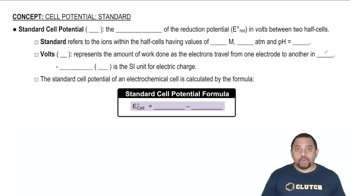
Cell potential (E) is the measure of the voltage produced by an electrochemical cell during a redox reaction. It reflects the tendency of the cell to drive the reaction forward; a higher cell potential indicates a greater likelihood of the reaction occurring spontaneously. In the context of the silver oxide-zinc battery, the given voltage of 1.60 V is essential for calculating the free-energy change using the Gibbs Free Energy equation.
Video consigliato:
Percorso guidato
01:27
Standard Cell Potential

Faraday's Constant

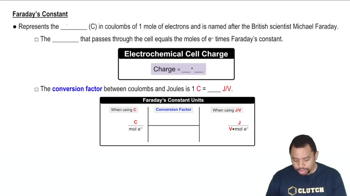
Faraday's Constant (F) is the amount of electric charge per mole of electrons, approximately 96485 C/mol. It is a key value in electrochemistry, linking the amount of substance involved in a reaction to the electric charge required to drive that reaction. In calculations involving electrochemical cells, Faraday's Constant is used to convert the cell potential and the number of moles of electrons into Gibbs Free Energy, allowing for the determination of the energy change associated with the cell reaction.
Video consigliato:
Percorso guidato
01:40
Faraday's Constant in Electrochemistry