
Ch.2 - Atoms, Molecules & Ions
McMurry - Chemistry 8th Edition
McMurry8th EditionChemistryISBN: 9781292336145Non è quello che usi tu?Cambia libro di testo
Capitolo 2, Problema 116

Copper has two naturally occurring isotopes, including 65Cu. Look at the periodic table and tell whether the second isotope is 63Cu or 66Cu.

Guida verificata passo dopo passo
1
Step 1: Understand that the atomic mass of an element on the periodic table is a weighted average of the masses of its naturally occurring isotopes.
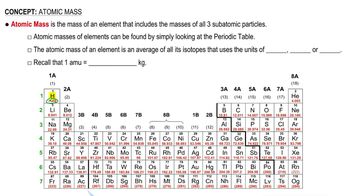
Step 2: Locate copper (Cu) on the periodic table and note its atomic mass, which is approximately 63.55 amu.
Step 3: Recognize that copper has two naturally occurring isotopes: 65Cu and another isotope that we need to identify.
Step 4: Consider the possible isotopes: 63Cu and 66Cu. The atomic mass of copper (63.55 amu) is closer to 63 than to 66.
Step 5: Conclude that the second isotope is likely 63Cu, as the average atomic mass (63.55 amu) is closer to 63 than to 66, indicating a higher abundance of 63Cu compared to 65Cu.

Concetti chiave

Ecco i concetti essenziali che devi comprendere per rispondere correttamente alla domanda.

Isotopes

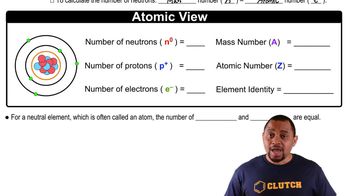
Isotopes are variants of a chemical element that have the same number of protons but different numbers of neutrons. This results in different atomic masses for the isotopes. For example, copper has isotopes like 63Cu and 65Cu, where the numbers represent the total number of protons and neutrons in the nucleus.
Video consigliato:

Atomic Mass

Atomic mass is the weighted average mass of an element's isotopes, measured in atomic mass units (amu). It reflects the relative abundance of each isotope in nature. In the case of copper, the atomic mass listed on the periodic table is influenced by the presence of its isotopes, which helps in identifying them.
Video consigliato:

Periodic Table

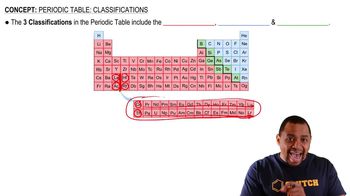
The periodic table organizes elements based on their atomic number, electron configuration, and recurring chemical properties. Each element's position provides information about its isotopes, atomic mass, and other characteristics. By examining the periodic table, one can determine the most common isotopes of an element, such as copper's isotopes 63Cu and 65Cu.
Video consigliato:
Percorso guidato
02:40
Periodic Table Classifications
Pratica correlata
Domanda del libro di testo
Match the descriptions (a)–(e) with the following terms: atomic weight, atomic mass, mass number, atomic number, molar mass. (a) The mass of a specific atom such as one atom of 13C (b) The quantity determined by the number of protons in an element. (c) The number of grams in 1 mol of an element (d) The number of protons and neutrons in an element (e) The weighted average of the isotopic masses of an element's naturally occurring isotopes
399
views
Domanda del libro di testo

(b) The mole is a unit used to represent a very large number of atoms. How many atoms are equivalent to 1 mol of atoms?

909
views
Domanda del libro di testo

Naturally occurring silver consists of two isotopes: 107^Ag (51.84%) with an isotopic mass of 106.9051 and 109^Ag (48.16%) with an isotopic mass of 108.9048. What is the atomic weight of silver? Check your answer in a periodic table.

3104
views
Domanda del libro di testo
A copper wire having a mass of 2.196 g was allowed to react with an excess of sulfur. The excess sulfur was then burned, yielding SO2 gas. The mass of the copper sulfide produced was 2.748 g. (c) Calculate the number of copper ions per cubic centimeter if the density of the copper sulfide is 5.6 g/cm3.
389
views
Domanda del libro di testo
Naturally occurring boron consists of two isotopes: 10^B (19.9%) with an isotopic mass of 10.0129 and 11^B (80.1%) with an isotopic mass of 11.009 31. What is the atomic weight of boron? Check your answer by looking at a periodic table.
1735
views