

Ch.2 - Atoms, Molecules & Ions
McMurry - Chemistry 8th Edition
McMurry8th EditionChemistryISBN: 9781292336145Non è quello che usi tu?Cambia libro di testo
Capitolo 2, Problema 88b

Label the following statements about J. J. Thomson's cathode-ray tube experiments shown in Figure 2.6 as true or false. (b) A cathode ray is a stream of charged particles.

Guida verificata passo dopo passo
1
Step 1: Understand the context of J.J. Thomson's cathode-ray tube experiments. In these experiments, J.J. Thomson discovered the electron by studying cathode rays. He found that these rays were made up of negatively charged particles, which he called 'corpuscles', but are now known as electrons.
Step 2: Analyze the statement 'A cathode ray is a stream of charged particles.' This statement is referring to the nature of the cathode rays that Thomson was studying.
Step 3: Recall that a cathode ray is indeed a stream of charged particles. These particles are electrons, which carry a negative charge.
Step 4: Therefore, the statement 'A cathode ray is a stream of charged particles' is true in the context of J.J. Thomson's cathode-ray tube experiments.
Step 5: Label the statement as true.

Risposta video verificata per un problema simile:

Questa soluzione video è stata consigliata dai nostri tutor come utile per risolvere questo problema.
Durata del video:
56s

Concetti chiave

Ecco i concetti essenziali che devi comprendere per rispondere correttamente alla domanda.

Cathode Rays

Cathode rays are streams of electrons emitted from the cathode in a vacuum tube. They are produced when high voltage is applied across electrodes, causing electrons to be ejected from the cathode and travel towards the anode. This phenomenon was crucial in the discovery of the electron and demonstrated that cathode rays are negatively charged particles.
Video consigliato:
Percorso guidato
01:35
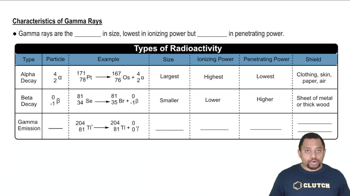
Characteristics of Gamma Rays

Charge of Particles

In Thomson's experiments, it was established that cathode rays are composed of negatively charged particles, later identified as electrons. The charge of these particles was determined through their deflection in electric and magnetic fields, which showed that they are attracted to positive charges and repelled by negative charges, confirming their negative charge.
Video consigliato:
Percorso guidato
05:19
Subatomic Particles

Thomson's Experiment Significance

J. J. Thomson's cathode-ray tube experiments were pivotal in the field of atomic physics as they provided the first evidence of subatomic particles. His work led to the realization that atoms are not indivisible, as previously thought, but consist of smaller components, fundamentally changing the understanding of atomic structure and leading to the development of the 'plum pudding' model of the atom.
Video consigliato:
Percorso guidato
02:37
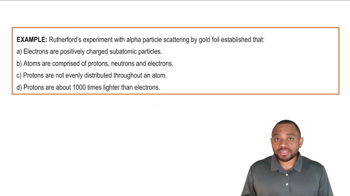
Rutherford Experiment Example