Ch.2 - Atoms, Molecules & Ions
McMurry - Chemistry 8th Edition
McMurry8th EditionChemistryISBN: 9781292336145Non è quello che usi tu?Cambia libro di testo
Capitolo 2, Problema 132

Use the data from the mass spectrum of a sample of an element to calculate the element's atomic weight. Identify the element.

Guida verificata passo dopo passo
1
Identify the isotopes present in the mass spectrum and their respective abundances.
For each isotope, multiply its mass by its relative abundance (expressed as a decimal).
Sum the values obtained from the previous step to get the weighted average mass.
The result from the previous step is the atomic weight of the element.
Compare the calculated atomic weight with known atomic weights of elements to identify the element.

Risposta video verificata per un problema simile:

Questa soluzione video è stata consigliata dai nostri tutor come utile per risolvere questo problema.
Durata del video:
3m

Concetti chiave

Ecco i concetti essenziali che devi comprendere per rispondere correttamente alla domanda.

Mass Spectrum

A mass spectrum is a graphical representation of the mass-to-charge ratio of ions. It provides information about the different isotopes of an element and their relative abundances. By analyzing the peaks in the spectrum, one can determine the mass of the isotopes and their proportions, which are essential for calculating the average atomic weight of the element.
Video consigliato:
Percorso guidato
02:53
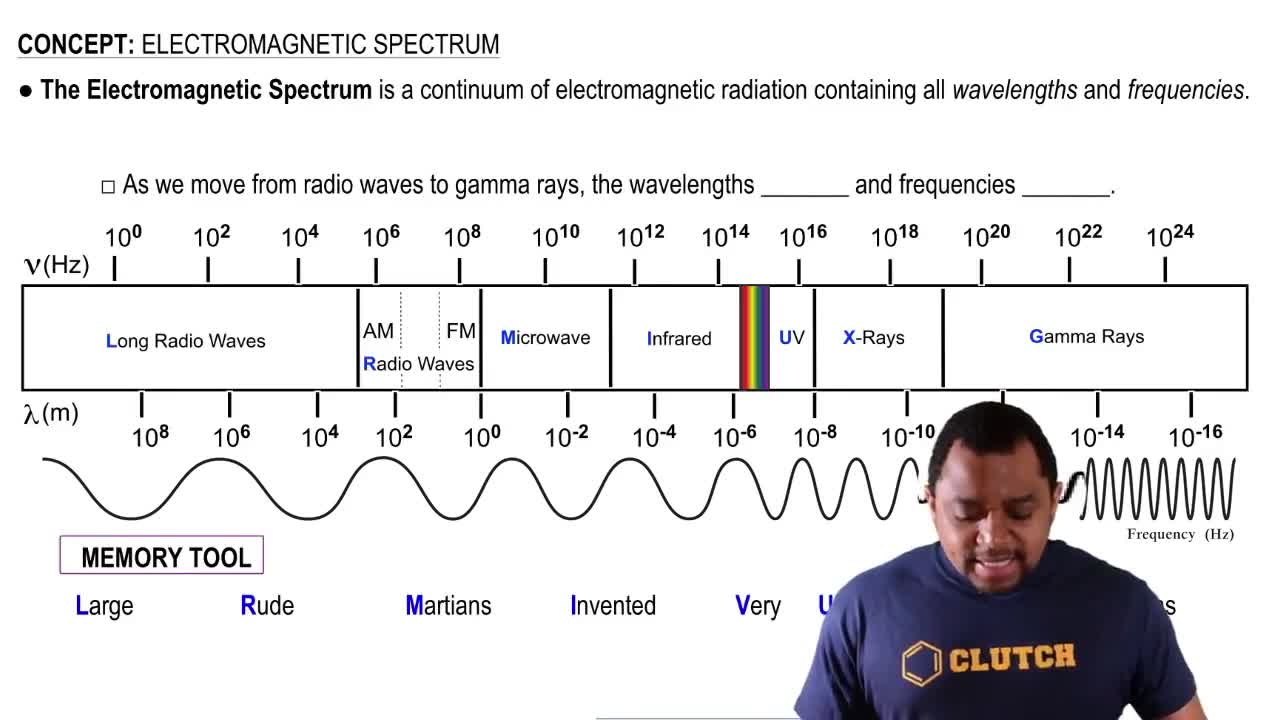
Electromagnetic Spectrum

Atomic Weight

Atomic weight, or atomic mass, is the weighted average mass of an element's isotopes based on their natural abundance. It is expressed in atomic mass units (amu) and reflects the mass of an atom relative to the mass of carbon-12. To calculate the atomic weight from mass spectrum data, one multiplies the mass of each isotope by its relative abundance and sums these values.
Video consigliato:

Isotopes

Isotopes are variants of a chemical element that have the same number of protons but different numbers of neutrons, resulting in different atomic masses. For example, carbon has isotopes like carbon-12 and carbon-14. Understanding isotopes is crucial for interpreting mass spectra, as the presence of multiple isotopes affects the calculated atomic weight and helps identify the element.
Video consigliato: