Ch.2 - Atoms, Molecules & Ions
McMurry - Chemistry 8th Edition
McMurry8th EditionChemistryISBN: 9781292336145Non è quello che usi tu?Cambia libro di testo
Capitolo 2, Problema 66

Without looking at a periodic table, list as many halogens as you can. (There are four common ones.)

Guida verificata passo dopo passo
1
Understand that halogens are elements found in Group 17 of the periodic table.
Recall that the most common halogens include fluorine, chlorine, bromine, and iodine.
Remember that these elements are known for their high reactivity, especially with alkali metals and alkaline earth metals.
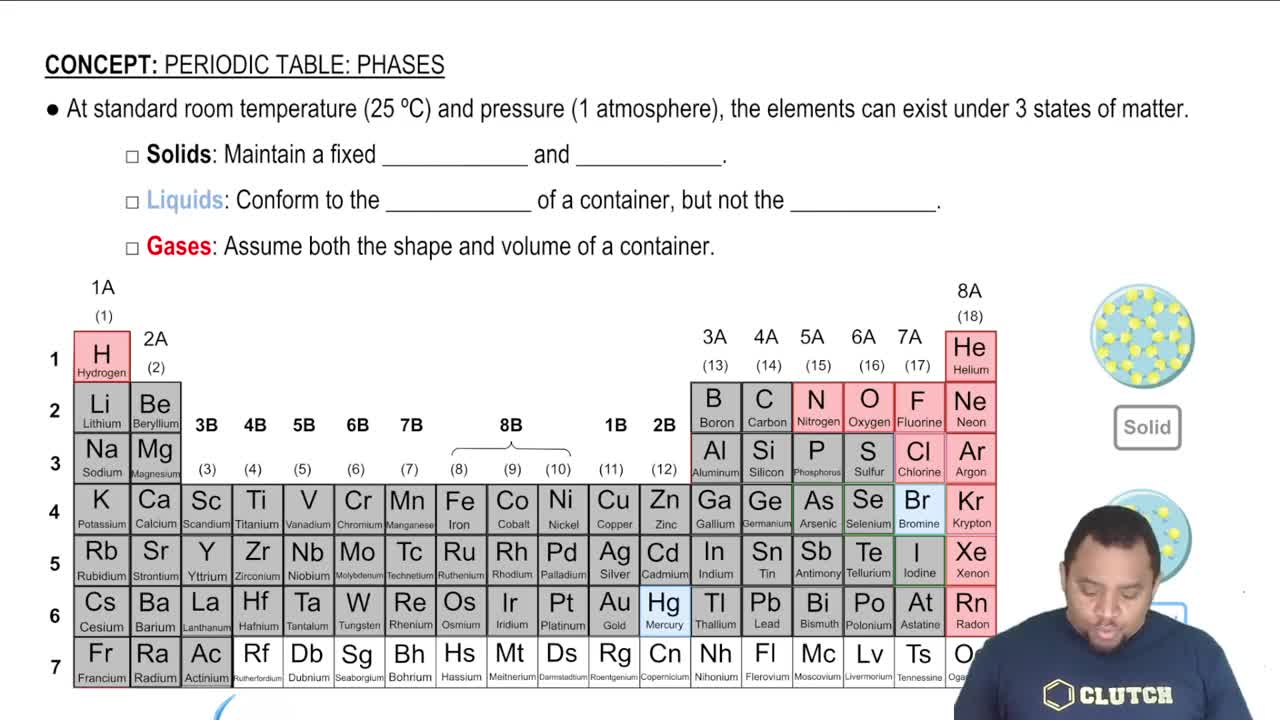
Note that halogens are nonmetals and exist in various physical states at room temperature: fluorine and chlorine are gases, bromine is a liquid, and iodine is a solid.
Consider that halogens are used in many applications, such as disinfectants, in the production of salts, and in halogen lamps.

Risposta video verificata per un problema simile:

Questa soluzione video è stata consigliata dai nostri tutor come utile per risolvere questo problema.
Durata del video:
2m

Concetti chiave

Ecco i concetti essenziali che devi comprendere per rispondere correttamente alla domanda.

Halogens

Halogens are a group of elements found in Group 17 of the periodic table. They are known for their high reactivity, particularly with alkali and alkaline earth metals, forming salts. The four most common halogens are fluorine, chlorine, bromine, and iodine, each exhibiting distinct physical and chemical properties.
Video consigliato:
Percorso guidato
01:11
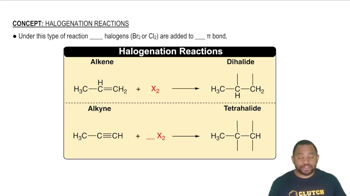
Halogenation Reactions

Chemical Reactivity

Chemical reactivity refers to the tendency of a substance to undergo chemical changes when it interacts with other substances. Halogens are highly reactive due to their seven valence electrons, which makes them eager to gain one more electron to achieve a stable octet configuration. This reactivity is a key characteristic that defines their behavior in chemical reactions.
Video consigliato:
Percorso guidato
03:31
Chemical Properties

States of Matter

The states of matter refer to the distinct forms that different phases of matter take on. Halogens exist in different states at room temperature: fluorine and chlorine are gases, bromine is a liquid, and iodine is a solid. Understanding these states helps in predicting their behavior and applications in various chemical processes.
Video consigliato:
Percorso guidato
03:25
Element States of Matter