
Ch.2 - Atoms, Molecules & Ions
McMurry - Chemistry 8th Edition
McMurry8th EditionChemistryISBN: 9781292336145Non è quello che usi tu?Cambia libro di testo
Capitolo 2, Problema 67

Without looking at a periodic table, list as many noble gases as you can. (There are six common ones.)

Guida verificata passo dopo passo
1
Step 1: Recall that noble gases are elements in Group 18 of the periodic table.
Step 2: Remember that noble gases are characterized by having a full valence shell, making them very stable and unreactive.
Step 3: Think about the common noble gases you might have encountered in everyday life or in chemistry classes.
Step 4: Consider the lighter noble gases that are often used in lighting and balloons.
Step 5: Reflect on the heavier noble gases that are less common but still part of the noble gas group.

Risposta video verificata per un problema simile:

Questa soluzione video è stata consigliata dai nostri tutor come utile per risolvere questo problema.
Durata del video:
2m

Concetti chiave

Ecco i concetti essenziali che devi comprendere per rispondere correttamente alla domanda.

Noble Gases

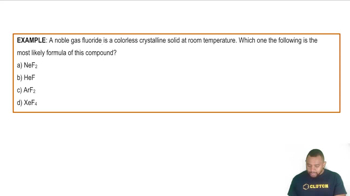
Noble gases are a group of chemical elements in Group 18 of the periodic table, known for their lack of reactivity due to having a full valence shell of electrons. This makes them stable and unlikely to form chemical bonds with other elements. The six common noble gases are helium, neon, argon, krypton, xenon, and radon.
Video consigliato:
Percorso guidato
00:44
Noble Gas Compounds Example

Atomic Structure

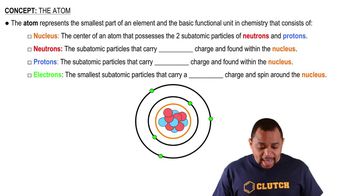
The atomic structure of an element consists of protons, neutrons, and electrons. In noble gases, the complete outer electron shell contributes to their inertness. Understanding atomic structure helps explain why noble gases do not readily participate in chemical reactions, distinguishing them from other elements.
Video consigliato:

Chemical Reactivity

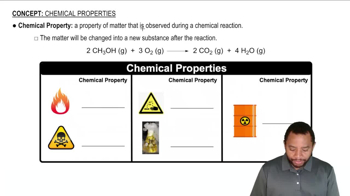
Chemical reactivity refers to the tendency of an element to engage in chemical reactions. Noble gases exhibit very low reactivity due to their stable electron configuration, which means they do not easily gain, lose, or share electrons. This property is crucial for identifying noble gases and understanding their unique position in the periodic table.
Video consigliato:
Percorso guidato
03:31
Chemical Properties