Ch.2 - Atoms, Molecules & Ions
McMurry - Chemistry 8th Edition
McMurry8th EditionChemistryISBN: 9781292336145Non è quello che usi tu?Cambia libro di testo
Capitolo 2, Problema 150

Write formulas for the following compounds: (a) Calcium acetate (b) Iron(II) cyanide (c) Sodium dichromate (d) Chromium(III) sulfate (e) Mercury(II) perchlorate

Guida verificata passo dopo passo
1
Identify the ions involved in each compound. For example, calcium acetate involves the calcium ion (Ca^2+) and the acetate ion (CH3COO^-).
Determine the charge of each ion. Calcium has a +2 charge, acetate has a -1 charge, iron(II) has a +2 charge, cyanide has a -1 charge, etc.
Balance the total positive and negative charges to ensure the compound is electrically neutral. For instance, since calcium has a +2 charge and each acetate has a -1 charge, you need two acetate ions to balance one calcium ion.
Write the chemical formula by placing the cation first followed by the anion. Use subscripts to indicate the number of each ion needed to balance the charges.
For polyatomic ions that appear more than once in the formula, use parentheses to group them together before adding a subscript. For example, in calcium acetate, write it as Ca(CH3COO)2.

Risposta video verificata per un problema simile:

Questa soluzione video è stata consigliata dai nostri tutor come utile per risolvere questo problema.
Durata del video:
41s

Concetti chiave

Ecco i concetti essenziali che devi comprendere per rispondere correttamente alla domanda.

Ionic Compounds

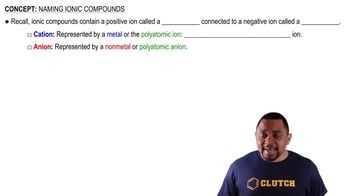
Ionic compounds are formed when metals react with nonmetals, resulting in the transfer of electrons. The metal loses electrons to become a positively charged cation, while the nonmetal gains electrons to become a negatively charged anion. The electrostatic attraction between these oppositely charged ions creates a stable compound. Understanding the formation of ionic compounds is essential for writing their chemical formulas.
Video consigliato:
Percorso guidato
02:11
Ionic Compounds Naming

Nomenclature of Coordination Compounds

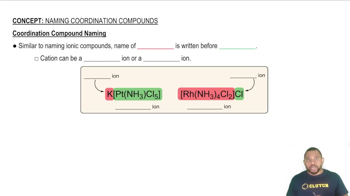
Coordination compounds consist of a central metal atom bonded to surrounding molecules or ions called ligands. The nomenclature rules for these compounds involve identifying the oxidation state of the metal and naming the ligands appropriately. For example, in Iron(II) cyanide, the Roman numeral indicates the +2 oxidation state of iron, which is crucial for determining the correct formula.
Video consigliato:
Percorso guidato
01:32
Coordination Compound Naming

Polyatomic Ions

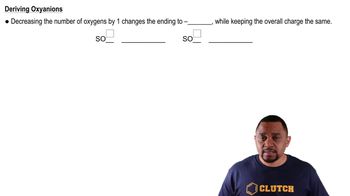
Polyatomic ions are ions composed of two or more atoms that are covalently bonded and carry a net charge. Common examples include sulfate (SO4^2-) and perchlorate (ClO4^-). Recognizing these ions is vital for accurately writing the formulas of compounds that contain them, as they often dictate the overall charge balance in ionic compounds.
Video consigliato:
Percorso guidato
01:20
Polyatomic Ion Variations