Ch.20 - Nuclear Chemistry
McMurry - Chemistry 8th Edition
McMurry8th EditionChemistryISBN: 9781292336145Non è quello che usi tu?Cambia libro di testo
Capitolo 20, Problema 80a

Calculate the binding energy (in MeV/nucleon) for the following nuclei. (a)58Ni (atomic mass = 57.93535)

Guida verificata passo dopo passo
1
Identify the number of protons and neutrons in the nucleus of \(^{58}\text{Ni}\). Nickel (Ni) has an atomic number of 28, so it has 28 protons. The number of neutrons is calculated as 58 (mass number) - 28 (protons) = 30 neutrons.
Calculate the total mass of the protons and neutrons if they were free particles. Use the mass of a proton (1.00728 u) and the mass of a neutron (1.00866 u). Multiply the mass of a proton by the number of protons and the mass of a neutron by the number of neutrons, then sum these values.
Determine the mass defect by subtracting the actual atomic mass of \(^{58}\text{Ni}\) (57.93535 u) from the total mass of the free protons and neutrons calculated in the previous step.
Convert the mass defect from atomic mass units (u) to energy in mega-electronvolts (MeV) using the conversion factor: 1 u = 931.5 MeV.
Calculate the binding energy per nucleon by dividing the total binding energy (in MeV) by the total number of nucleons (58) in the \(^{58}\text{Ni}\) nucleus.

Risposta video verificata per un problema simile:

Questa soluzione video è stata consigliata dai nostri tutor come utile per risolvere questo problema.
Durata del video:
8m

Concetti chiave

Ecco i concetti essenziali che devi comprendere per rispondere correttamente alla domanda.

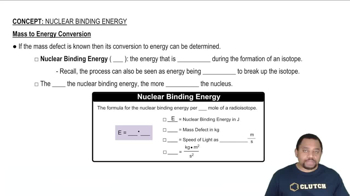
Binding Energy

Binding energy is the energy required to disassemble a nucleus into its constituent protons and neutrons. It is a measure of the stability of a nucleus; higher binding energy indicates a more stable nucleus. This energy can be calculated using the mass defect, which is the difference between the mass of the individual nucleons and the mass of the nucleus itself.
Video consigliato:
Percorso guidato
02:06
Nuclear Binding Energy

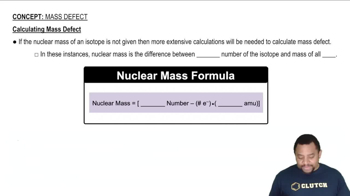
Mass Defect

The mass defect is the difference between the total mass of the separate nucleons and the actual mass of the nucleus. This discrepancy arises because some mass is converted into energy when nucleons bind together, according to Einstein's equation E=mc². The mass defect is crucial for calculating the binding energy of a nucleus.
Video consigliato:
Percorso guidato
00:55
Calculating Mass Defect

MeV/nucleon

MeV/nucleon is a unit of measurement that expresses binding energy per nucleon in mega-electronvolts. This unit allows for easy comparison of the stability of different nuclei, as it normalizes the binding energy to the number of nucleons. It is commonly used in nuclear physics to assess the energy efficiency of nuclear reactions.
Video consigliato:
Percorso guidato
01:38
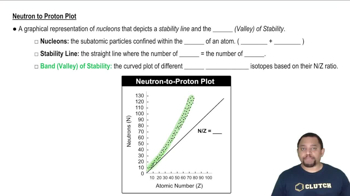
Neutron-to-Proton Plot