Ch.20 - Nuclear Chemistry
McMurry - Chemistry 8th Edition
McMurry8th EditionChemistryISBN: 9781292336145Non è quello che usi tu?Cambia libro di testo
Capitolo 20, Problema 82

What is the energy change ∆E (in kJ/mol) when an a particle is emitted from 174Ir? The atomic mass of 174Ir is 173.96666 the atomic mass of 170Re is 169.95804, and the atomic mass of a 4He atom is 4.00260.

Guida verificata passo dopo passo
1
Identify the initial and final products in the nuclear reaction. In this case, the initial product is 174Ir and the final products are 170Re and a 4He particle.
Write down the given atomic masses: Atomic mass of 174Ir = 173.96666 u, Atomic mass of 170Re = 169.95804 u, Atomic mass of 4He = 4.00260 u.
Calculate the total mass of the products by adding the atomic mass of 170Re and the atomic mass of 4He.
Subtract the total mass of the products from the atomic mass of the initial reactant (174Ir) to find the mass defect (∆m).
Convert the mass defect from atomic mass units to energy (in kJ/mol) using the conversion factor derived from Einstein's equation E=mc^2, where c is the speed of light. Remember to convert atomic mass units to kg and then multiply by Avogadro's number to convert to moles.

Risposta video verificata per un problema simile:

Questa soluzione video è stata consigliata dai nostri tutor come utile per risolvere questo problema.
Durata del video:
7m

Concetti chiave

Ecco i concetti essenziali che devi comprendere per rispondere correttamente alla domanda.

Nuclear Reactions

Nuclear reactions involve changes in an atom's nucleus, leading to the emission of particles such as alpha particles (4He). In this context, the emission of an alpha particle from 174Ir transforms it into a different element, 170Re, and is a key process in understanding the energy changes associated with radioactive decay.
Video consigliato:
Percorso guidato
02:06
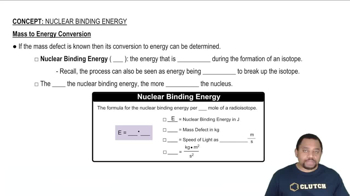
Nuclear Binding Energy

Mass-Energy Equivalence

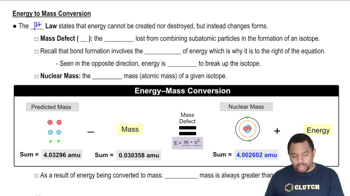
Mass-energy equivalence, expressed by Einstein's equation E=mc², indicates that mass can be converted into energy. In nuclear reactions, the difference in mass before and after the reaction (mass defect) is converted into energy, which can be calculated to find the energy change (∆E) associated with the emission of particles.
Video consigliato:
Percorso guidato
04:12
Energy to Mass Conversion

Binding Energy

Binding energy is the energy required to disassemble a nucleus into its constituent protons and neutrons. It is crucial for calculating the energy change during nuclear reactions, as the binding energy of the products and reactants determines the overall energy released or absorbed when particles are emitted or absorbed.
Video consigliato:
Percorso guidato
02:06
Nuclear Binding Energy