Ch.20 - Nuclear Chemistry
McMurry - Chemistry 8th Edition
McMurry8th EditionChemistryISBN: 9781292336145Non è quello che usi tu?Cambia libro di testo
Capitolo 20, Problema 98b

Give the products of the following nuclear reactions. (b)

Guida verificata passo dopo passo
1
Identify the type of nuclear reaction given in the problem. Common types include alpha decay, beta decay, gamma decay, and nuclear fission or fusion.
Write down the nuclear equation for the reaction. This involves identifying the reactants and the products, including any particles such as neutrons, protons, or other nuclei.
Apply the law of conservation of mass and the law of conservation of charge. This means that the sum of the mass numbers (top numbers) and the sum of the atomic numbers (bottom numbers) must be equal on both sides of the equation.
Determine the missing product(s) by balancing the nuclear equation. This may involve identifying a missing particle or nucleus that balances the equation.
Verify the stability and identity of the products by checking against known nuclear data or decay series, ensuring that the products are reasonable and expected for the given reaction.

Risposta video verificata per un problema simile:

Questa soluzione video è stata consigliata dai nostri tutor come utile per risolvere questo problema.
Durata del video:
3m

Concetti chiave

Ecco i concetti essenziali che devi comprendere per rispondere correttamente alla domanda.

Nuclear Reactions

Nuclear reactions involve changes in an atom's nucleus and can result in the transformation of one element into another. These reactions can be classified into types such as fusion, fission, and radioactive decay. Understanding the type of nuclear reaction is crucial for predicting the products formed, as each type follows specific rules and conservation laws.
Video consigliato:
Percorso guidato
02:06
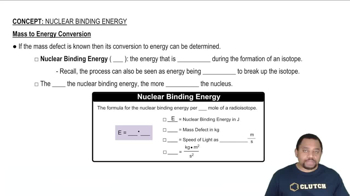
Nuclear Binding Energy

Conservation Laws

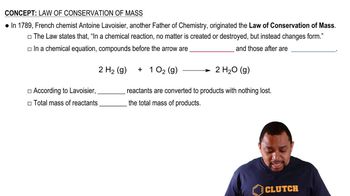
In nuclear reactions, certain quantities are conserved, including mass-energy and charge. The conservation of mass-energy states that the total mass and energy before the reaction must equal the total after the reaction. Similarly, the conservation of charge ensures that the total charge remains constant throughout the reaction, which is essential for determining the products formed.
Video consigliato:
Percorso guidato
01:48
Law of Conservation of Mass

Nuclear Notation

Nuclear notation is a way to represent isotopes and nuclear reactions using symbols that include the element's chemical symbol, atomic number, and mass number. For example, uranium-235 is denoted as ²³⁵U. Understanding nuclear notation is vital for identifying reactants and products in nuclear reactions, as it provides essential information about the particles involved.
Video consigliato:
Percorso guidato
02:50
Standard Notation to Scientific Notation